
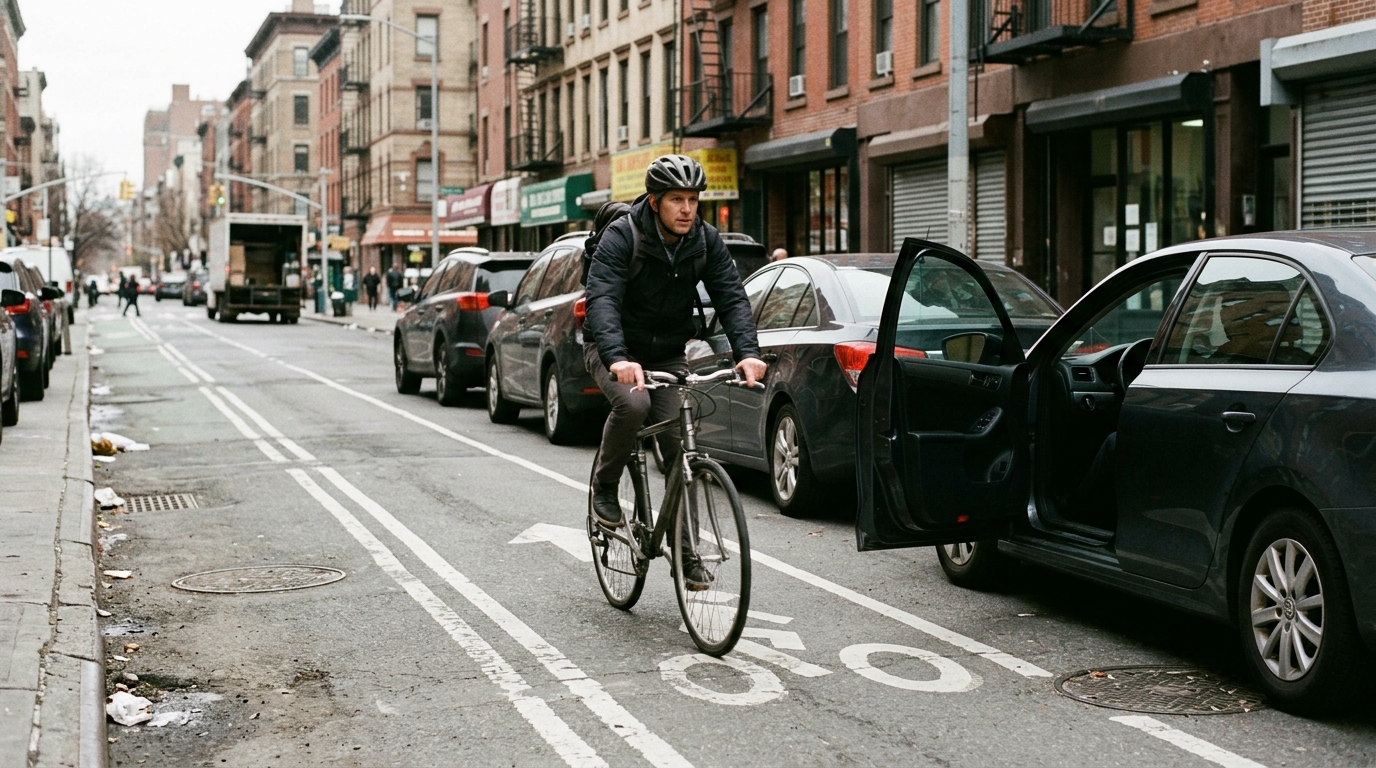

A bicycle dooring accident happens when a driver or passenger opens a vehicle door into the path of an approaching cyclist. These collisions can cause serious injuries, even when the vehicle itself is parked. A cyclist may strike the door, be thrown onto the pavement, or swerve into passing traffic to avoid a collision.
In New York, opening a vehicle door into moving traffic without ensuring that it is reasonably safe can violate state traffic law. An injured cyclist may have grounds to pursue compensation when negligent conduct causes or contributes to the accident.
Understanding New York’s vehicle door laws, liability rules, insurance coverage, evidence requirements, and filing deadlines is essential when evaluating a bicycle dooring accident claim.
Quick Answer
Who is responsible for a bicycle dooring accident in New York?
A driver or passenger who opens a vehicle door into an approaching cyclist’s path may be responsible for the resulting injuries. New York Vehicle and Traffic Law § 1214 prohibits opening a motor vehicle door toward moving traffic unless it is reasonably safe and does not interfere with that traffic.
However, responsibility is not automatically established in every case. The investigation must determine how the door was opened, whether the cyclist was visible, whether the door created an immediate hazard, and whether either party’s conduct contributed to the accident.
A bicycle dooring injury claim may involve compensation for medical expenses, lost income, pain and suffering, and other legally recoverable losses.
Key Takeaways
- New York Door-Opening Law: Vehicle and Traffic Law § 1214 requires people to ensure that a vehicle door can be opened safely without interfering with moving traffic.
- Potential Liability: Drivers, passengers, vehicle owners, and other parties may have relevant legal responsibilities depending on the circumstances.
- Bicycle Lane Protection: A vehicle door opened into a bicycle lane can create a dangerous obstruction even when the vehicle is legally parked.
- Important Evidence: Photographs, surveillance footage, witness statements, vehicle damage, and medical documentation can help establish negligence.
- Insurance Coverage: Automobile liability insurance and qualifying no-fault benefits may be relevant, but coverage must be evaluated according to the accident circumstances.
- Comparative Negligence: A cyclist’s own conduct may affect compensation, including under the updated rules applicable to certain motor vehicle injury claims.
- Filing Deadlines: Many New York personal injury lawsuits must be filed within three years, while insurance notices and some government-related claims have shorter deadlines.
What Is a Bicycle Dooring Accident?
A bicycle dooring accident occurs when someone opens or leaves open a vehicle door in a manner that interferes with an approaching cyclist.
The incident often happens alongside parallel parking spaces, particularly where bicycles travel close to parked vehicles.
A cyclist approaching the vehicle may have only a moment to react after a door swings outward.
Direct-Impact Dooring Accidents
In a direct-impact collision, the cyclist strikes the open vehicle door.
Depending on the cyclist’s speed and the door’s position, the impact may damage the bicycle or throw the rider forward.
These accidents can cause injuries to the head, shoulders, arms, knees, and other parts of the body.
Accidents Involving Sudden Evasive Maneuvers
Some dooring accidents do not involve direct contact with the vehicle door.
A cyclist may brake suddenly, lose balance, or swerve to avoid the obstruction.
If the maneuver causes the rider to fall or collide with another vehicle, a negligence claim may still be possible.
However, the evidence must establish that the unsafe door-opening conduct caused or contributed to the resulting accident.
Dooring Accidents Involving Moving Traffic
A particularly dangerous situation occurs when a cyclist moves away from an open door and enters an adjacent traffic lane.
The cyclist may then be struck by another vehicle or lose control while attempting to avoid the obstruction.
An investigation may need to evaluate the conduct of both the door-opening occupant and nearby motorists.
What Does New York Law Say About Opening Vehicle Doors?
New York Vehicle and Traffic Law § 1214 directly addresses the opening and closing of vehicle doors.
Supporting Image #1 Download here
ALT: Driver checking for bicycle traffic before opening a parked vehicle door
The statute generally prohibits a person from opening a motor vehicle door on the side available to moving traffic until the maneuver can be completed reasonably safely without interfering with traffic.
It also restricts leaving such a door open longer than necessary for loading or unloading passengers.
The law applies to people opening vehicle doors, not only the person driving.
The official New York vehicle door-opening statute provides the governing language.
Does the Law Protect Bicycle Riders?
Yes.
Bicycles are legitimate road users, and cyclists may be directly affected when a vehicle occupant opens a door into their travel path.
The law does not require a cyclist to collide with a moving automobile before an unsafe door-opening violation becomes relevant.
A parked vehicle can create an immediate hazard when its door extends into an approaching rider’s path.
Can a Passenger Violate the Door-Opening Law?
Yes.
Vehicle and Traffic Law § 1214 refers to anyone opening a motor vehicle door toward moving traffic.
A passenger who opens a door without checking for approaching bicycles may therefore violate the statute.
The passenger’s conduct, the vehicle’s ownership, and available insurance coverage may require separate investigation.
What If the Vehicle Was Legally Parked?
Legal parking does not automatically make it safe to open a vehicle door.
A car may be properly positioned in a parking space while its occupant still creates a hazard by opening the door into moving traffic.
The relevant question is whether the door-opening maneuver was reasonably safe under the circumstances.
Who Can Be Liable for a Dooring Bicycle Accident?
Liability depends on who caused the dangerous condition and whether that conduct resulted in the cyclist’s injuries.
More than one person or entity may have relevant responsibility.
The Driver Who Opened the Door
A driver may be negligent when opening a door without checking mirrors, observing approaching traffic, or ensuring sufficient clearance.
Potentially relevant circumstances include:
- Opening the door directly into a bicycle lane
- Failing to check for approaching cyclists
- Leaving the door open in an active travel area
- Opening the door immediately before a cyclist reaches the vehicle
- Ignoring visible bicycle traffic
- Opening the door when visibility is obstructed without taking reasonable precautions
The driver’s conduct must be connected to the accident and resulting injuries.
A Passenger Who Opened the Door
Passengers also have responsibilities when exiting a motor vehicle.
A passenger who suddenly opens a door into an approaching cyclist’s path may be negligent.
The identity of the person who opened the door can be especially important when establishing liability.
The Vehicle Owner
A vehicle owner’s potential responsibility depends on applicable ownership-liability principles and the circumstances.
New York Vehicle and Traffic Law § 388 can impose liability on certain vehicle owners for qualifying negligent operation or use by people driving with permission.
However, whether that provision applies to a specific passenger-door incident requires legal analysis.
Ownership alone should not be assumed to establish liability in every dooring claim.
Employers and Commercial Vehicle Operators
Dooring accidents may involve taxis, delivery vehicles, rideshare vehicles, or company-owned automobiles.
Additional questions may arise when an employee opens a door while performing work-related duties.
An employer may potentially be responsible for an employee’s negligence under applicable legal principles when the conduct occurs within the scope of employment.
The vehicle’s ownership, the person’s employment status, and the circumstances of the incident must be reviewed.
Other Motorists
A second motorist may contribute to an accident when a cyclist swerves around an open door and is struck by another vehicle.
The investigation may need to determine whether that driver was maintaining a proper lookout, traveling at a safe speed, and complying with other traffic obligations.
An injured rider may consult a bicycle accident attorney to assess the door-opening conduct, vehicle ownership, accident evidence, and possible sources of compensation.
What Do New York Court Decisions Say About Bicycle Dooring Accidents?
New York appellate decisions demonstrate the importance of Vehicle and Traffic Law § 1214 when evaluating accidents caused by improperly opened vehicle doors.
Garcia v. BLS Limousine Service of New York, Inc. (2021)
In Garcia v. BLS Limousine Service of New York, Inc., a cyclist was struck by a vehicle door opened by a driver.
The driver testified that he opened the door toward moving traffic without first looking for approaching vehicles.
The Appellate Division, First Department affirmed the determination of liability against the defendants.
The court relied on the unsafe door-opening conduct and the cyclist’s testimony that there was insufficient time to avoid the collision.
The decision illustrates how evidence of a failure to check for approaching cyclists can support liability.
Baker v. Michaels Electrical Supply Corp. (2025)
In Baker v. Michaels Electrical Supply Corp., the Appellate Division, Second Department considered another accident involving a vehicle door opened toward moving traffic.
Although the plaintiff presented evidence supporting a Vehicle and Traffic Law § 1214 violation, the defendants submitted a competing account raising factual questions about how the incident occurred and whether comparative negligence was involved.
The court determined that those factual disputes prevented the requested summary judgment.
What These Cases Demonstrate
These decisions show why the circumstances of the accident matter.
Evidence supporting an unsafe door-opening maneuver may establish a strong negligence argument.
However, conflicting accounts, disputed visibility, and the conduct of the parties may require additional fact-finding.
A claim should therefore be evaluated using reliable documentation rather than assuming that every dooring accident produces the same outcome.
What Evidence Is Important in a Dooring Bicycle Accident Claim?
Evidence helps establish who opened the door, whether the cyclist had adequate time to react, and how the incident caused injuries.
Supporting Image #2 Download here
ALT: Damaged bicycle front wheel and accident documentation from a dooring collision
Because the vehicle door may be closed and the scene cleared shortly afterward, early documentation can be particularly useful.
| Evidence | Why It Matters |
| Police accident report | Records the participants, reported circumstances, and initial observations |
| Accident scene photographs | Documents the vehicle’s position, bicycle lane, and surrounding roadway |
| Vehicle door damage | May help identify the location and nature of the impact |
| Bicycle damage | Can help demonstrate the collision mechanism |
| Surveillance footage | May show when the door opened and the cyclist’s approach |
| Witness statements | Provides independent accounts of the incident |
| Dashcam footage | May document traffic movement and accident timing |
| Medical records | Establishes injuries, treatment, and recovery |
| Insurance information | Helps identify potentially applicable policies |
| Employment records | May become relevant when a commercial vehicle or employee is involved |
Photographs of the Scene
Photographs may document where the vehicle was parked, the surrounding road markings, and the location of the bicycle.
Images showing the relationship between the parked vehicle and a designated bicycle lane may be particularly useful.
A photograph taken from the cyclist’s approach direction may also help demonstrate visibility.
Surveillance and Dashcam Footage
Nearby businesses, residential security cameras, commercial vehicles, and private dashcams may capture a dooring accident.
Footage can sometimes establish whether the door opened suddenly or had already been open for some time.
Because recording systems may overwrite footage, identifying possible sources promptly is important.
Witness Statements
Independent witnesses may be able to describe the driver’s actions, the cyclist’s position, and the timing of the collision.
Witnesses may also help establish whether the rider had a reasonable opportunity to avoid the door.
Physical Damage
Damage to the vehicle door, bicycle handlebars, front wheel, or frame may help establish the mechanics of the collision.
Photographs and inspection records can preserve evidence that might otherwise disappear after repairs.
Medical Records
Medical documentation helps establish the type, severity, and progression of injuries.
Relevant records may include emergency treatment, diagnostic imaging, surgery notes, physical therapy documentation, and physician-imposed work restrictions.
What Should Someone Do After a Bicycle Dooring Accident?
The immediate response should prioritize safety and medical care.
Once urgent needs are addressed, additional steps may help preserve important evidence.
1. Obtain Medical Attention
Seek emergency assistance when serious injuries are suspected.
Head trauma, severe pain, fractures, significant bleeding, or difficulty moving may require immediate evaluation.
Even when symptoms initially appear manageable, a medical assessment may help identify injuries that need treatment.
2. Report the Accident
Contact law enforcement when appropriate and obtain information about the responding agency.
An official report may help document the date, location, and people involved.
3. Identify the Person Who Opened the Door
Determine whether the driver or a passenger opened the vehicle door.
Collect the person’s name and contact information when possible.
4. Obtain Vehicle and Insurance Information
Record the vehicle’s registration, owner information, and available insurance details.
If the vehicle was used commercially, note the business or service involved.
5. Photograph the Bicycle and Vehicle
Document bicycle damage, the opened-door location, road markings, and nearby traffic conditions.
Photographs should be taken only when it is safe to do so.
6. Identify Witnesses and Cameras
Collect contact information from witnesses.
Look for nearby businesses or vehicles that may have recorded the accident.
7. Preserve Damaged Equipment
Avoid immediately discarding or substantially modifying damaged bicycle components, helmets, or other relevant equipment.
These items may help establish the impact and resulting injuries.
8. Maintain Medical and Financial Records
Save medical bills, treatment summaries, prescription receipts, transportation costs, and documentation of missed work.
9. Review Insurance Deadlines
Where a qualifying automobile insurance claim may be available, prompt notice is important.
New York’s no-fault notice requirements can be significantly shorter than the period for filing a personal injury lawsuit.
How Does Insurance Work After a Bicycle Dooring Accident?
Bicycle dooring accidents may involve automobile insurance because the dangerous condition originates from a motor vehicle.
However, insurance coverage depends on the facts and policy terms.
Can Automobile Liability Insurance Apply?
Potentially, yes.
When a vehicle occupant negligently opens a door and injures a cyclist, the vehicle’s applicable liability insurance may be relevant.
The insurer may investigate whether the insured person was legally responsible and whether the incident falls within the policy’s coverage.
Coverage should not be assumed solely because the vehicle was insured.
Can a Cyclist Receive No-Fault Benefits?
New York’s automobile no-fault system generally provides qualifying benefits for people injured through the use or operation of covered motor vehicles.
Bicyclists struck by motor vehicles may qualify for no-fault coverage under the applicable rules.
However, a dooring incident involving a stationary vehicle may raise questions about whether the injuries arose from covered vehicle use or operation.
A claim may therefore require separate evaluation of the precise circumstances and insurance policy.
The New York Department of Financial Services’ no-fault guidance explains the general benefits and reporting requirements.
What Expenses Can No-Fault Insurance Cover?
Where qualifying coverage applies, New York’s basic no-fault benefits generally provide up to $50,000 for specified economic losses.
Covered categories may include:
- Necessary medical expenses
- Certain rehabilitation costs
- Qualifying portions of lost earnings
- Certain transportation and household assistance expenses
The specific amounts and conditions are governed by insurance law and applicable policy provisions.
No-fault benefits do not automatically compensate an injured person for pain and suffering.
What Is the No-Fault Notice Deadline?
New York generally requires written notice of a no-fault claim within 30 calendar days after the accident.
Exceptions may be available when a claimant provides a legally sufficient justification for delayed notice.
Because coverage and filing requirements can be complicated, the applicable insurer should be identified promptly.
What If the Vehicle Was Uninsured?
An uninsured vehicle may create additional challenges.
Depending on the facts, potentially available remedies may include qualifying uninsured motorist coverage or other statutory insurance mechanisms.
Eligibility, priority of coverage, notice requirements, and the circumstances of the accident must be reviewed.
What Injuries Are Common in Bicycle Dooring Accidents?
Cyclists have limited physical protection when they collide with vehicle doors or fall onto pavement.
The severity of injuries depends on the rider’s speed, impact direction, surrounding traffic, and other circumstances.
Head and Brain Injuries
A cyclist may strike their head against a door, vehicle, pavement, or another object.
Possible injuries include concussions, skull fractures, and more serious traumatic brain injuries.
Neurological symptoms may require ongoing evaluation and treatment.
Shoulder and Collarbone Injuries
A rider thrown sideways or forward may land heavily on the shoulder.
Collarbone fractures, dislocations, and soft tissue damage may result.
Wrist and Arm Fractures
Cyclists often extend their arms to break a fall.
This can cause wrist, elbow, or forearm fractures.
Knee and Leg Injuries
Direct contact with a vehicle or pavement may cause ligament injuries, fractures, and other lower-extremity damage.
Spinal Injuries
Serious falls may injure the neck, back, or spinal cord.
These injuries can affect mobility, employment, and long-term functioning.
Road Rash and Soft Tissue Damage
Sliding across pavement may cause abrasions and other soft tissue injuries.
Severe cases can require extensive wound care, rehabilitation, or reconstructive treatment.
What Compensation May Be Available After a Dooring Accident?
Potential compensation depends on the injuries, legal responsibility, available insurance, and supporting evidence.
Medical Expenses
A qualifying claim may include emergency treatment, hospitalization, surgery, imaging, prescriptions, rehabilitation, and ongoing medical care.
Future treatment costs may also be relevant when supported by medical evidence.
Lost Wages
An injured cyclist may be unable to work during recovery.
Recoverable losses may include missed wages and other qualifying income-related damages.
Reduced Earning Capacity
Serious injuries may prevent a person from returning to previous employment or performing the same duties.
Future earning losses require appropriate supporting evidence.
Pain and Suffering
A negligence claim may involve compensation for physical pain, emotional distress, and reduced enjoyment of normal activities.
However, when a claim is governed by New York Insurance Law Article 51, recovery of non-economic damages generally requires a legally qualifying serious injury.
The 2026 amendments narrowed the statutory serious injury definition for covered actions commenced on or after May 26, 2026, including removal of the former 90/180-day category.
Whether those requirements apply to a particular dooring claim depends on its legal and insurance classification.
Bicycle and Personal Property Damage
The accident may damage a bicycle, helmet, clothing, phone, or other belongings.
Photographs, purchase records, and repair estimates can help document these losses.
Long-Term Medical and Functional Losses
Severe injuries may require continuing rehabilitation, mobility assistance, or other long-term care.
Future expenses and permanent limitations may be considered when legally recoverable.
Can Comparative Negligence Affect a Bicycle Dooring Claim?
Yes.
An injured cyclist’s conduct may become relevant when the parties dispute responsibility for the accident.
For example, an insurer may question the cyclist’s speed, road position, attention, or compliance with applicable traffic controls.
However, a cyclist does not automatically become negligent simply because they were riding near parked vehicles.
How Does New York’s General Comparative Negligence Rule Work?
Under CPLR § 1411(a), a claimant’s own negligence generally reduces recoverable damages in proportion to their share of fault.
For example, if a qualifying claim has $100,000 in established damages and the cyclist is found 20% responsible, the proportional reduction would be $20,000.
That example is illustrative only and does not predict a settlement.
What Changed Under New York’s 2026 Law?
New York amended CPLR § 1411 and provisions of Insurance Law Article 51, effective May 26, 2026, for actions and proceedings commenced on or after that date.
For covered personal injury actions subject to Article 51, the revised rule can bar recovery when the claimant’s fault exceeds the combined fault of the defendants.
This differs from the ordinary proportional fault rule.
However, not every bicycle accident claim is necessarily governed by Article 51.
The applicability of the new restriction depends on the legal nature of the claim.
Does Riding Near Parked Cars Establish Negligence?
No.
Cyclists may lawfully travel on roads and designated bicycle infrastructure where parked vehicles are present.
The presence of parked cars does not relieve occupants of their duty to open vehicle doors safely.
Any comparative fault argument requires evidence of the cyclist’s conduct and its contribution to the accident.
How Long Does Someone Have to File a Bicycle Dooring Accident Claim in New York?
Under CPLR § 214(5), most negligence-based personal injury lawsuits in New York must be commenced within three years.
However, other deadlines may apply depending on the circumstances.
| Claim or Requirement | General Deadline Consideration |
| Ordinary negligence-based personal injury lawsuit | Generally three years |
| Qualifying automobile no-fault notice | Generally within 30 days, subject to justified late notice |
| Certain claims against municipalities | May require a notice of claim within 90 days |
| Covered municipal negligence lawsuit | Generally one year and 90 days |
| Claims involving New York State | Separate Court of Claims Act procedures may apply |
| Insurance claims and policy notices | Depend on applicable statutory and policy requirements |
Why Is the General Three-Year Deadline Not Always Enough?
An injured cyclist may need to preserve insurance benefits much sooner than the lawsuit deadline.
Additionally, accidents involving government vehicles or public entities may be subject to special notice requirements.
The correct deadline depends on the potential defendant and the type of claim.
The New York Courts’ statute of limitations timetable explains the general filing period for personal injury actions.
Why Should Evidence Be Preserved Early?
Vehicles may be repaired, bicycle components replaced, and surveillance footage overwritten.
Witnesses may also become difficult to locate as time passes.
Preserving evidence shortly after the accident can help establish the original conditions.
What Mistakes Can Weaken a Bicycle Dooring Accident Claim?
Several mistakes may make it harder to establish liability, causation, or damages.
Common problems include:
- Failing to identify who opened the vehicle door
- Not photographing the parked vehicle and bicycle lane
- Failing to obtain witness contact information
- Overlooking nearby surveillance cameras
- Discarding damaged bicycle components
- Delaying medical evaluation despite symptoms
- Providing speculative statements about accident speed or timing
- Assuming the driver is automatically liable without investigating the evidence
- Assuming no-fault benefits automatically apply to every parked-vehicle dooring incident
- Failing to identify all potentially relevant insurance policies
- Accepting a settlement before understanding long-term injuries
- Missing insurance notice or lawsuit filing deadlines
A well-supported claim relies on reliable evidence connecting the unsafe door-opening conduct to the collision and resulting injuries.
When May Legal Guidance Be Useful?
Legal guidance may be particularly valuable when a bicycle dooring accident results in significant injuries, disputed liability, uncertain insurance coverage, or long-term medical consequences.
Supporting Image #3 Download here
ALT: Bicycle dooring accident injury consultation reviewing insurance and accident evidence
Additional investigation may be needed when a passenger opened the door, a commercial vehicle was involved, or the cyclist swerved into another vehicle.
The claim may require examination of Vehicle and Traffic Law § 1214, insurance documents, accident footage, medical evidence, and comparative negligence rules.
A car accident attorney may also help evaluate automobile insurance and vehicle-related liability questions when a dooring incident involves an insured motor vehicle.
People researching local legal services may review a Long Island injury law office when seeking information about bicycle accident claims in Nassau or Suffolk County.
Every accident requires an individual assessment, and the fact that a vehicle door was involved does not guarantee compensation.
Frequently Asked Questions About Dooring Bicycle Accidents
Can a cyclist sue someone for opening a car door into a bicycle lane?
Yes. A cyclist may pursue a negligence claim when someone opens a vehicle door into the rider’s path and causes an injury. New York Vehicle and Traffic Law § 1214 requires vehicle doors to be opened safely without interfering with moving traffic. Liability depends on the evidence, causation, and applicable legal rules.
Is a passenger responsible for a bicycle dooring accident in New York?
Potentially, yes. New York’s door-opening law applies to people opening motor vehicle doors, including passengers. A passenger may be negligent when opening a door into approaching bicycle traffic without checking whether it is safe. Vehicle ownership, insurance coverage, and responsibility of other parties may also require evaluation.
Can a cyclist file a claim without hitting the open car door?
Possibly. A claim may be available when a cyclist loses control or collides with another object while reasonably attempting to avoid a negligently opened vehicle door. The evidence must establish that the unsafe door-opening conduct caused or contributed to the accident and resulting injuries.
Does automobile insurance cover bicycle dooring injuries?
Automobile liability insurance may apply when a vehicle occupant negligently opens a door and injures a cyclist. Qualifying no-fault benefits may also be available, but parked-vehicle incidents can raise questions about coverage. The applicable policy, circumstances of the accident, and statutory insurance rules must be evaluated.
How long does someone have to file a dooring accident claim in New York?
Most ordinary negligence-based personal injury lawsuits in New York have a three-year filing period. However, qualifying no-fault insurance claims generally require written notice within 30 days, subject to exceptions. Government-related claims may involve additional deadlines, so the applicable procedures should be identified promptly.
Conclusion
Dooring bicycle accident claims in New York often depend on whether a driver or passenger opened a vehicle door without ensuring that it was reasonably safe. Vehicle and Traffic Law § 1214 establishes an important duty designed to prevent vehicle doors from interfering with moving traffic, including cyclists.
However, establishing liability requires examining the door-opening maneuver, accident timing, road conditions, cyclist’s conduct, and resulting injuries. Surveillance footage, photographs, witness statements, physical damage, and medical documentation may all play important roles.
Automobile insurance coverage and New York’s updated comparative negligence rules can add complexity to these cases, especially when a parked vehicle or multiple parties are involved.
Understanding the applicable legal duties, insurance requirements, available compensation, and filing deadlines can help injured cyclists evaluate potential claims using reliable evidence.