


Cotton-feel and performance scrubs approach comfort differently. Cotton-feel fabrics are often chosen for their soft, familiar hand feel and fluid drape, while performance-oriented fabrics typically emphasize durability, moisture management, stretch, wrinkle resistance, and easy care. For healthcare professionals working long shifts, the better option depends on the work environment, movement requirements, laundering routine, climate, and personal preference.
Modern scrub fabrics can also combine characteristics traditionally associated with different materials. Blended constructions may use polyester for durability, rayon for softness and drape, and spandex for flexibility. This means healthcare professionals do not necessarily have to choose between a soft feel and practical performance.
Key Takeaways
- Cotton-feel scrubs prioritize a soft, familiar hand feel and comfortable drape.
- Performance scrubs generally emphasize durability, stretch, easy care, moisture management, or wrinkle resistance.
- Fabric fiber content alone does not determine comfort. Weave, weight, construction, fit, and finishing also matter.
- Polyester can contribute strength and shape retention, while rayon can add softness and drape.
- Spandex or elastane can provide stretch and support freedom of movement.
- Breathability depends on the fabric construction and garment fit, not simply whether a scrub is cotton or synthetic.
- Long-shift comfort involves more than softness. Heat, movement, waistband comfort, pocket placement, and fabric recovery all matter.
- A cotton-feel performance blend can provide a middle ground between traditional softness and modern durability.
- The right scrub fabric depends on the professional’s work environment and personal priorities.
What Is the Difference Between Cotton-Feel and Performance Scrubs?
The primary difference is the set of characteristics emphasized by the fabric and garment construction.
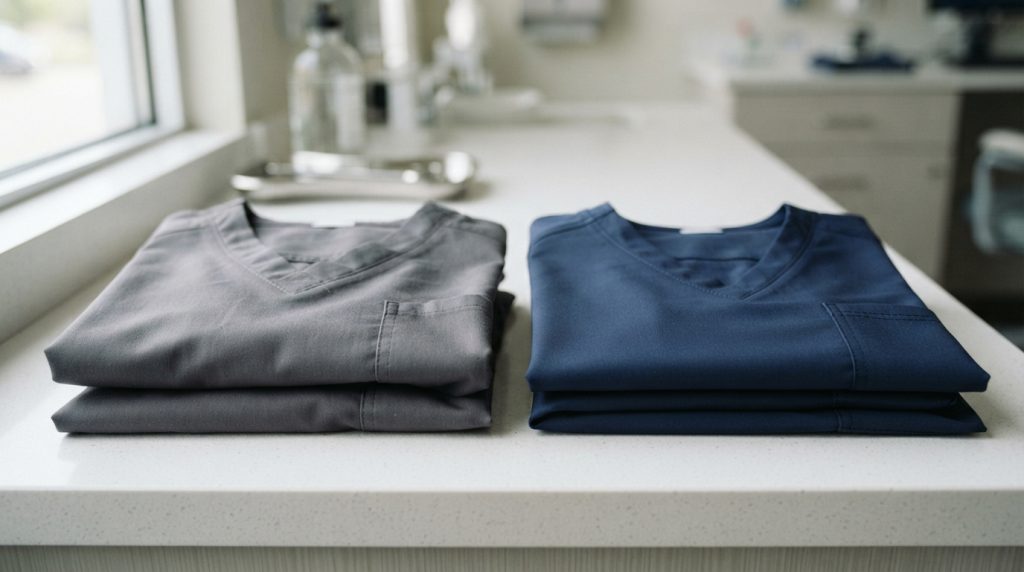
Cotton-feel scrubs are designed to provide a soft, familiar textile sensation similar to traditional cotton garments.
Performance scrubs are generally engineered around functional characteristics such as:
- Stretch
- Shape retention
- Moisture management
- Durability
- Wrinkle resistance
- Easy care
- Lightweight construction
These categories can overlap.
A scrub can have a cotton-like feel while still using synthetic and regenerated fibers to improve durability, flexibility, or maintenance.
What Does “Cotton-Feel” Mean in Scrub Fabric?
“Cotton-feel” generally describes how a fabric feels rather than confirming that it is made primarily from cotton.
The sensation can involve:
- Softness
- Low surface harshness
- Comfortable drape
- Reduced synthetic feel
- Familiar textile texture
Fiber content should always be checked separately.
For example, the Edge collection uses a 65% polyester, 32% rayon, and 3% spandex blend. The manufacturer describes the construction as providing a cotton-like feel while combining polyester durability, rayon softness, and spandex stretch.
This illustrates why “cotton-feel” and “cotton fabric” should not be treated as interchangeable terms.
What Are Performance Scrubs?
Performance scrubs are generally designed around measurable or practical garment characteristics rather than only traditional textile feel.
Depending on the fabric and construction, performance characteristics can include:
- Stretch
- Moisture management
- Breathability
- Wrinkle resistance
- Shape retention
- Durability
- Lightweight construction
- Easy laundering
Not every performance scrub has every characteristic.
The term describes a design approach rather than a single standardized fabric composition.
Is Cotton More Comfortable Than Performance Fabric?
Not necessarily.
Comfort is influenced by several variables, including:
- Fabric softness
- Garment fit
- Fabric weight
- Breathability
- Stretch
- Moisture management
- Seam construction
- Waistband design
- Temperature
- Work activity
A soft fabric can feel comfortable initially but become less comfortable if the garment is too warm or restrictive.
Likewise, a performance fabric can feel comfortable throughout a shift if its construction provides appropriate airflow, stretch, and moisture management.
Does Cotton Feel Softer Than Polyester?
Traditional cotton often has a familiar soft hand feel, while untreated polyester can feel different.
However, fabric technology can substantially change how polyester-containing blends feel.
Finishing, fiber shape, yarn construction, weave, and blending can all affect the final textile.
This is why comparing fiber names alone does not provide a complete picture of how a scrub garment will feel.
What Does Rayon Add to Scrub Fabric?
Rayon can contribute softness, fluid drape, and moisture-absorbing characteristics to a textile.
In a blended scrub fabric, rayon can help create a softer hand feel while other fibers contribute different performance characteristics.
The Edge blend, for example, combines rayon with polyester and spandex rather than relying on a single fiber to provide every desired characteristic.
This type of blended construction is one way scrub manufacturers can balance comfort and functionality.
What Does Polyester Add to Scrubs?
Polyester can contribute:
- Strength
- Durability
- Shape retention
- Resistance to repeated wear
- Relatively easy care
Its performance depends on the specific construction and finishing.
Polyester also tends to absorb less moisture into the fiber itself than cotton or rayon, although polyester fabrics can be engineered to manage moisture across the fabric surface.
What Does Spandex Add to Scrubs?
Spandex, also known as elastane, contributes stretch.
Even a small percentage can provide additional flexibility in areas that experience movement.
Stretch can be particularly useful when healthcare professionals:
- Bend
- Reach
- Walk quickly
- Sit and stand repeatedly
- Move equipment
- Assist patients
The Edge fabric blend contains 3% spandex, while individual garment construction also contributes to how much movement the clothing permits.
Which Fabric Is Better for Long Shifts?
There is no universal answer.
For long shifts, the important question is whether the garment maintains comfort across several hours of movement.
Evaluate:
| Factor | Cotton-Feel Priority | Performance Priority |
| Soft Hand Feel | High | Varies |
| Breathability | Depends on construction | Depends on construction |
| Stretch | Depends on blend | Often emphasized |
| Durability | Depends on fiber blend | Often emphasized |
| Wrinkle Resistance | Varies | Often emphasized |
| Easy Care | Varies | Often emphasized |
| Moisture Management | Depends on fabric | Often emphasized |
| Shape Retention | Depends on blend | Often emphasized |
| Familiar Textile Feel | Often strong | Varies |
The ideal fabric is the one that addresses the wearer’s actual working conditions.
How Does Fabric Affect Comfort During a 12-Hour Shift?
Long-shift comfort is cumulative.
A garment that feels acceptable for one hour can become uncomfortable after repeated:
- Walking
- Bending
- Sitting
- Reaching
- Sweating
- Temperature changes
Several small sources of discomfort can become significant over time.
These can include:
- Tight shoulders
- Restrictive waistband
- Excess fabric
- Poor airflow
- Heavy material
- Fabric cling
- Rough seams
- Poor stretch recovery
This is why fabric should be evaluated together with garment construction and fit.
Does Softness Matter During a Long Shift?
Yes, but softness is only one part of comfort.
A soft fabric may feel pleasant against the skin, particularly during extended wear.
However, softness alone does not guarantee:
- Good airflow
- Appropriate stretch
- Durability
- Moisture management
- Easy care
For long shifts, a balanced fabric can be more useful than a single characteristic taken in isolation.
Does Breathability Matter More Than Softness?
The answer depends on the environment and individual.
In warm clinical settings or physically active roles, heat management may become more important.
A very soft fabric that feels warm can become uncomfortable.
Conversely, a breathable fabric that feels less familiar may still provide better overall comfort during active work.
What Affects Scrub Breathability?
Breathability is influenced by:
- Fiber characteristics
- Fabric weave
- Fabric weight
- Garment fit
- Layering
- Ambient temperature
- Physical activity
The science of scrub fabrics involves more than fiber labels. Fabric construction and garment fit both influence how air and moisture move through clothing.
Can a Cotton-Feel Fabric Be Breathable?
Yes.
Cotton-feel describes tactile sensation rather than automatically defining airflow.
A blended fabric can provide a soft feel while also being constructed to support airflow.
The specific garment’s:
- Fiber blend
- Weave
- Weight
- Fit
- Panel construction
all influence the final wearing experience.
Can Performance Scrubs Feel Soft?
Yes.
Performance fabrics do not have to feel stiff or synthetic.
Modern blends can combine fibers with different characteristics to create a softer hand feel while maintaining practical performance.
A performance-oriented scrub may therefore feel substantially different from older generations of synthetic uniforms.
How Does Fabric Stretch Affect Long-Shift Comfort?
Stretch becomes particularly important when work requires frequent movement.

A scrub garment with appropriate stretch can accommodate:
- Shoulder movement
- Hip movement
- Knee bending
- Reaching
- Squatting
- Sitting
However, stretch should not be confused with unlimited flexibility.
The garment still needs appropriate ease and construction.
What Is Stretch Recovery?
Stretch recovery describes a fabric’s ability to return toward its original shape after being stretched.
Good recovery can help a garment maintain:
- Shape
- Fit
- Appearance
- Pocket position
Poor recovery can contribute to:
- Bagging at the knees
- Loose waistbands
- Distorted garment shape
For professionals who wear the same garments frequently, recovery can matter as much as initial stretch.
Are Cotton-Feel Scrubs Good for Nurses?
Cotton-feel scrubs can be useful for nurses who prioritize a soft, familiar textile sensation while still wanting practical features.
Nursing work can involve substantial movement, making:
- Stretch
- Comfortable fit
- Breathability
- Pocket placement
- Fabric recovery
important considerations.
The Edge scrubs by IRG collection provides one example of a cotton-feel blended approach, using polyester, rayon, and spandex to combine different fabric characteristics.
The specific fit and garment style should still be selected according to the individual’s work routine.
Are Performance Scrubs Good for Nurses?
Performance-oriented scrubs can be useful for nurses who prioritize:
- Frequent movement
- Easy maintenance
- Durability
- Stretch
- Lightweight construction
- Moisture management
The usefulness depends on the specific garment.
A performance label should not be treated as a guarantee of superior comfort.
Review the actual:
- Fabric composition
- Garment construction
- Fit
- Care instructions
- Pocket configuration
before making a decision.
What Should Male Healthcare Professionals Look for in Scrub Fabric?
Men’s scrub garments may use the same basic fabric technologies as women’s uniforms, but fit and garment construction can differ.
Important considerations include:
- Shoulder room
- Chest fit
- Sleeve movement
- Waistband comfort
- Rise
- Thigh room
- Inseam
- Pocket placement
Professionals shopping for medical scrubs for men can evaluate fabric and fit together rather than choosing based only on fiber composition.
Does Men’s Scrub Fit Affect Fabric Comfort?
Yes.
Even a soft, breathable fabric can become uncomfortable if the garment restricts movement.
A men’s scrub top should allow appropriate room across the:
- Chest
- Shoulders
- Back
- Arms
Scrub pants should allow comfortable movement through the:
- Waist
- Hips
- Thighs
- Knees
Fabric and fit work together.
What Should Women Look for in Scrub Fabric?
Women’s scrub garments may use shaped construction to create a more tailored silhouette.
Important factors can include:
- Bust fit
- Shoulder movement
- Waist shaping
- Hip room
- Inseam
- Rise
- Stretch
The women’s medical scrubs category provides a starting point for evaluating different silhouettes, but the specific garment measurements remain important.
Does a Tailored Scrub Need More Stretch?
Not automatically.
A tailored garment can remain comfortable if it provides sufficient ease and appropriate construction.
Stretch becomes especially useful where fabric needs to accommodate movement without losing the intended silhouette.
Is Cotton-Feel Fabric Better for Sensitive Skin?
Softness can be an important consideration for anyone who finds certain textiles uncomfortable.
However, fabric comfort is highly individual.
Possible contributors include:
- Fiber type
- Fabric finish
- Seam construction
- Tightness
- Heat
- Sweat
- Detergent residue
If a specific skin concern persists with clothing, a healthcare professional can provide appropriate individualized advice.
Which Fabric Is Better in Hot Weather?
A lightweight, breathable garment may be more comfortable in warm conditions.
The label “cotton” or “performance” alone does not determine heat comfort.
Consider:
- Fabric weight
- Weave
- Garment fit
- Airflow
- Moisture management
- Number of layers
A loose-fitting, lightweight performance blend may feel cooler than a heavier natural-fiber garment.
Likewise, a lightweight cotton-blend garment can also perform well in warm conditions.
Which Fabric Is Better in Cold Clinical Environments?
Temperature control works differently in cooler settings.
A healthcare professional working in an air-conditioned hospital may value:
- Slightly more fabric coverage
- Lightweight layering
- Scrub jackets
- Long-sleeve base layers where permitted
The scrub fabric itself does not need to provide all thermal protection.
Layering can make it easier to adapt to changing temperatures.
Do Performance Scrubs Wrinkle Less?
Many performance-oriented fabrics are designed to resist wrinkling, but results depend on fiber composition and garment construction.
Wrinkle resistance can be useful for professionals who:
- Wear scrubs frequently
- Have limited time for ironing
- Carry uniforms in bags
- Commute before work
Care labels should still be followed.
Wrinkle resistance does not mean the garment can never wrinkle.
Are Cotton Scrubs More Likely to Wrinkle?
Cotton can wrinkle more readily than some synthetic fibers.
However, wrinkle behavior depends on:
- Fiber blend
- Fabric finish
- Weave
- Garment construction
- Washing and drying
A cotton-blend scrub can behave differently from a 100% cotton garment.
Which Scrubs Are Easier to Care For?
Easy-care performance varies by garment.
When evaluating care requirements, look for:
- Machine-wash instructions
- Drying requirements
- Wrinkle resistance
- Colorfastness
- Shrinkage considerations
A polyester-containing blend may offer practical advantages for frequent laundering, but the garment’s care label remains the correct source for maintenance instructions.
Why Does Easy Care Matter for Healthcare Workers?
Healthcare professionals may wear uniforms repeatedly throughout the week.
A scrub that can be:
- Washed regularly
- Dried according to the care label
- Stored easily
- Worn without extensive pressing
can simplify uniform maintenance.
The practical value becomes more noticeable when several scrub sets are rotated throughout a workweek.
How Does Frequent Washing Affect Scrub Fabric?
Frequent laundering can gradually affect:
- Color
- Elasticity
- Surface appearance
- Fabric hand
- Seams
- Garment shape
This makes durability important for healthcare professionals who wash uniforms regularly.
A scrub fabric designed for repeated wear should maintain its intended characteristics through normal care when the garment is handled according to its instructions.
Is Rayon Durable Enough for Scrubs?
Rayon contributes useful properties such as softness and drape, but its behavior depends on the specific rayon type and blend.
In a blended scrub fabric, other fibers can contribute additional strength and recovery.
This is one reason blended textiles are common in medical apparel.
The Edge blend combines rayon with polyester and spandex rather than relying on rayon alone.
Is Polyester Better Than Cotton for Durability?
Polyester is generally valued for strength and durability, while cotton is valued for softness and familiar comfort.
But a direct fiber-versus-fiber comparison does not capture the performance of a finished garment.
A blended textile can combine characteristics from multiple fibers.
The better question is:
What properties does the complete fabric provide?
Do Cotton-Feel Scrubs Pill?
Pilling depends on:
- Fiber characteristics
- Yarn construction
- Fabric construction
- Friction
- Laundering
- Garment use
A cotton-feel description does not automatically predict pilling.
Similarly, a performance fabric is not automatically immune to pilling.
Look for manufacturer information and follow care instructions.
Do Performance Scrubs Fade?
Color retention depends on:
- Dye method
- Fiber
- Fabric construction
- Washing conditions
- Detergent
- Water temperature
- Drying
A performance label alone does not guarantee color retention.
When maintaining frequently worn scrubs, following the care label can help preserve the garment’s intended appearance.
How Important Is Fabric Weight?
Fabric weight influences how a scrub feels during wear.
Lightweight fabrics can provide:
- Less bulk
- Easier movement
- Lower perceived warmth
Heavier fabrics may provide:
- More structure
- Greater coverage
- A more substantial feel
The right weight depends on climate, activity level, workplace temperature, and layering.
How Does Fit Affect Fabric Performance?
Fit can change how a fabric behaves.
A garment that is too tight may:
- Restrict movement
- Reduce perceived breathability
- Increase fabric tension
- Create more friction
A garment that is too loose may:
- Create excess fabric
- Interfere with movement
- Add bulk
- Shift during activity
Even a technically advanced fabric cannot compensate for a poorly fitting garment.
What Role Do Seams Play in Comfort?
Seam placement can affect how a scrub feels during repeated movement.
Potentially important areas include:
- Shoulders
- Underarms
- Side seams
- Waist
- Crotch
- Knees
A well-designed garment can use seams to provide shape and movement without creating excessive friction.
Why Do Side Vents Matter?
Side vents can provide additional movement around the lower portion of a scrub top.
They may help with:
- Sitting
- Reaching
- Bending
- Hip movement
Several Edge garments use side vents as part of their construction. For example, the women’s V-neck top includes side vents and a shaped design intended to support movement.
Do Pocket Designs Affect Comfort?
Yes.
A pocket is useful only if its placement works with the wearer’s movement.
Consider:
- Pocket depth
- Pocket opening
- Pocket position
- Reinforcement
- Storage capacity
Overloading pockets can make even comfortable scrubs feel heavy.
Are Cargo Pockets Useful for Long Shifts?
Cargo pockets can provide additional storage without placing everything in the front pockets.
This can be useful for professionals who routinely carry approved lightweight work items.
However, heavy pocket contents can:
- Pull on the garment
- Distort the silhouette
- Affect movement
- Increase overall clothing weight
Storage should therefore be based on actual work requirements.
How Do Yoga Waistbands Affect Comfort?
A wider knit waistband can distribute pressure across a larger area.
Depending on the construction, it may provide:
- Flexible fit
- Reduced pressure points
- Comfortable movement
- Secure positioning
The Edge women’s yoga-waist pant, for example, uses a knit waistband with a drawstring and a semi-tapered leg.
Waistband comfort remains personal, so the construction should be evaluated with the complete garment.
How Do Jogger Scrubs Affect Comfort?
Jogger pants generally use a tapered leg and ankle cuff.
Potential benefits include:
- Controlled lower-leg fabric
- Modern silhouette
- Secure ankle position
- Reduced loose fabric
The Edge women’s jogger includes a knit waistband, ankle cuff, drawstring, multiple pockets, and a knitted back yoke.
The men’s Edge jogger also provides a knit waistband and leg cuff, drawstring, and multiple pockets.
Are Cotton-Feel Scrubs Good for Active Healthcare Jobs?
They can be, particularly when the fabric blend includes enough stretch and the garment provides appropriate movement.
An active healthcare role may involve:
- Walking
- Bending
- Reaching
- Lifting
- Repeated sitting and standing
The fabric should support these movements without excessive pulling.
The Edge collection combines a cotton-like feel with a polyester/rayon/spandex blend, while individual garments use construction features such as side vents, stretch-related materials, and movement-oriented silhouettes.
Are Performance Scrubs Better for Active Healthcare Jobs?
Performance-oriented fabrics can be useful where durability, stretch, moisture management, or easy care are priorities.
But “performance” should always be evaluated at the garment level.
Two performance scrubs can have very different:
- Fabric weights
- Stretch levels
- Fits
- Pocket layouts
- Breathability
- Care requirements
How Should You Compare Scrub Fabrics for Active Work?
Use a practical checklist:
- Check the fiber composition.
- Look for stretch content.
- Evaluate garment weight.
- Review fit.
- Check pocket placement.
- Consider breathability.
- Review care requirements.
- Consider how frequently the garment will be washed.
This produces a more useful evaluation than relying on a marketing category alone.
What Fabric Is Best for Nurses Working Long Shifts?
A long-shift scrub should support comfort across the entire workday.
Prioritize:
- Comfortable fit
- Appropriate stretch
- Breathability
- Manageable fabric weight
- Secure waistband
- Useful pockets
- Durable construction
- Practical care requirements
The balance between softness and performance is personal.
A nurse who values a familiar textile feel may prefer a cotton-feel blend, while another may prioritize moisture management, wrinkle resistance, or lightweight performance.
What Fabric Is Best for Doctors?
Doctors who spend much of the day in scrubs may prioritize:
- Professional appearance
- Easy care
- Comfortable fit
- Appropriate stretch
- Durable fabric
- Useful storage
For professionals who wear a lab coat over scrubs, the bulk of the scrub fabric can also matter.
A lightweight top can layer more easily beneath an outer garment.
What Fabric Is Best for Medical Students?
Medical students often have a combination of:
- Classroom work
- Simulation
- Clinical rotations
- Commuting
A versatile fabric can therefore be useful.
Priorities may include:
- Easy care
- Moderate stretch
- Comfortable fit
- Durability
- Lightweight construction
Because programs may specify colors and styles, uniform requirements should be checked before purchasing.
How Does Cost Affect the Choice Between Cotton-Feel and Performance Scrubs?
Price should be evaluated alongside expected use.
A scrub worn:
- Several times per week
- Throughout long shifts
- Through frequent laundering
needs to provide appropriate durability.
A lower-priced garment may be practical if it performs well for the intended use.
Likewise, a higher-priced scrub may be worthwhile if its features solve a specific problem.
The relevant question is not simply:
Which fabric costs more?
It is:
Which garment provides the characteristics needed for the intended work routine?
Are Cotton-Feel Scrubs Suitable for Group Uniforms?
They can be.
Group uniforms may prioritize:
- Consistent appearance
- Comfortable fit
- Broad size availability
- Multiple color options
- Easy care
- Durability
A blended fabric can provide a useful combination of comfort and maintenance characteristics for teams.
The employer or organization should still establish its own uniform requirements.
How Should Healthcare Professionals Choose Between Cotton-Feel and Performance Scrubs?
Use the work environment as the starting point.
Choose a Cotton-Feel-Oriented Fabric When:
- Soft hand feel is a major priority
- Familiar textile sensation matters
- Fluid drape is preferred
- The fabric still provides sufficient stretch and durability
Consider a Performance-Oriented Fabric When:
- Easy care is important
- Frequent washing is expected
- Stretch is a priority
- Wrinkle resistance matters
- Lightweight construction is preferred
- Moisture management is important
Consider a Blend When:
- Softness and durability are both important
- Stretch is needed
- A traditional cotton-like feel is preferred
- Easy-care characteristics are desirable
A blended fabric can bridge the gap between traditional textile comfort and modern performance characteristics.
How Can You Test Scrub Fabric Before Buying?
Online specifications provide useful information, but physical testing can reveal additional characteristics.

Touch the Fabric
Assess:
- Softness
- Surface texture
- Thickness
Stretch the Garment
Check:
- Ease of movement
- Stretch amount
- Recovery
Try the Garment On
Evaluate:
- Shoulder movement
- Waistband comfort
- Hip room
- Knee movement
Walk and Sit
Notice whether:
- Fabric pulls
- Pockets shift
- Waistband moves
- Pants bunch
Check the Fabric After Movement
Look for:
- Persistent wrinkling
- Knee bagging
- Waistband distortion
This provides a more realistic impression than standing still in front of a mirror.
What Should You Check on a Scrub Label?
Before purchasing, review:
- Fiber composition
- Care instructions
- Size information
- Garment construction
- Country of manufacture where provided
- Any stated special finishes
Fiber content is particularly important when comparing cotton-feel and performance fabrics.
A garment described as cotton-feel may contain little or no cotton, so the actual fiber composition should always be checked.
How Should Scrubs Be Cared For During Frequent Washing?
Follow the garment care label.
Basic maintenance may include:
- Emptying pockets
- Separating colors when instructed
- Using the recommended water temperature
- Following drying instructions
- Avoiding prohibited bleach or chemicals
- Removing garments promptly when appropriate
Care instructions are designed around the garment’s specific materials and construction.
Why Should You Follow the Care Label?
Incorrect laundering can affect:
- Elasticity
- Color
- Fabric surface
- Shape
- Seams
Even a durable scrub can deteriorate prematurely when exposed to care conditions outside the manufacturer’s recommendations.
Common Mistakes When Choosing Scrub Fabric
Choosing Based Only on Fiber Content
A fiber name does not tell the entire story.
Assuming Cotton Is Always Cooler
Fabric construction and garment fit also influence heat comfort.
Assuming Performance Means Uncomfortable
Modern blends can provide both softness and performance.
Choosing Softness Over Movement
A soft fabric can still be restrictive if the garment fits poorly.
Ignoring Fabric Weight
A heavy fabric may feel warm during active work.
Ignoring Stretch Recovery
Stretch without good recovery can affect long-term fit.
Choosing Based Only on Price
The least expensive garment may not provide the characteristics needed for frequent use.
Ignoring Care Requirements
A fabric that requires more maintenance may be less practical for a busy work schedule.
Overloading Pockets
Excess storage weight can undermine garment comfort.
Buying Multiple Sets Before Testing One
Test a new fabric and fit before purchasing an entire uniform rotation.
Cotton-Feel vs Performance Scrub Decision Checklist
Comfort
- Fabric feels comfortable against the skin
- Fit allows normal movement
- Waistband remains comfortable
- Seams do not create unnecessary irritation
Performance
- Stretch meets work requirements
- Fabric has appropriate recovery
- Weight suits the environment
- Breathability is adequate
- Moisture management meets expectations
Durability
- Fabric suits frequent laundering
- Seams are appropriately constructed
- Pockets are reinforced where needed
- Fabric maintains its intended shape
Maintenance
- Care instructions fit the work routine
- Drying requirements are manageable
- Wrinkle behavior is acceptable
- Color-care requirements are practical
Work Environment
- Color complies with workplace requirements
- Style is appropriate
- Pocket configuration suits the role
- Fabric works with required layering
- Garment supports the day’s movement
Conclusion
Cotton-feel and performance scrubs are not necessarily opposing categories.
Cotton-feel fabrics can prioritize softness and familiar comfort, while performance-oriented constructions often emphasize durability, stretch, easy care, moisture management, and shape retention. Modern blended fabrics can combine several of these characteristics in a single garment.
For long shifts, the most useful scrub is usually the one that maintains comfort while supporting the actual demands of the job.
A healthcare professional who values softness may prefer a cotton-feel blend. Someone who prioritizes easy maintenance, stretch, or moisture management may prefer a performance-oriented fabric. A blended construction can provide a middle ground when both comfort and function matter.
The decision should ultimately consider fabric composition, garment construction, fit, movement, climate, laundering routine, and workplace requirements, rather than relying on a single material label.
Frequently Asked Questions
Are cotton-feel scrubs better than performance scrubs?
Neither is universally better. Cotton-feel scrubs emphasize softness and familiar textile feel, while performance fabrics may emphasize stretch, durability, moisture management, wrinkle resistance, or easy care. A blended fabric can provide characteristics associated with both approaches.
Are performance scrubs comfortable for long shifts?
They can be. Long-shift comfort depends on fabric weight, fit, stretch, breathability, moisture management, waistband construction, and garment design. A performance label alone does not guarantee comfort, so the specific fabric and garment should be evaluated.
What makes a scrub fabric comfortable?
Comfort depends on several factors, including softness, fit, breathability, stretch, fabric weight, seam construction, waistband design, and moisture management. No single fiber automatically determines whether a scrub will remain comfortable throughout a long shift.
Is rayon good for medical scrubs?
Rayon can contribute softness and fluid drape to a scrub fabric. It is often blended with other fibers to balance different characteristics. For example, the Edge collection uses rayon with polyester and spandex rather than relying on rayon alone.
Is polyester good for scrubs?
Polyester can contribute durability, strength, and shape retention. Its performance depends on the specific fabric construction and finishing. Polyester can also be blended with other fibers to create a softer or more flexible scrub fabric.
What does spandex do in scrubs?
Spandex provides stretch and can help a scrub garment accommodate movement. Even a relatively small percentage can contribute flexibility, although the garment’s construction and fit also determine how freely it moves.
What should nurses look for in scrubs for long shifts?
Nurses should consider fit, stretch, breathability, fabric weight, waistband comfort, pocket placement, durability, and care requirements. Personal preference also matters because some professionals prioritize soft hand feel while others place greater emphasis on moisture management or easy care.
Are cotton-feel scrubs made from cotton?
Not necessarily. “Cotton-feel” generally describes the feel of the fabric rather than its fiber composition. For example, the Edge collection’s manufacturer identifies a blend of polyester, rayon, and spandex while describing the fabric as having a cotton-like feel.