
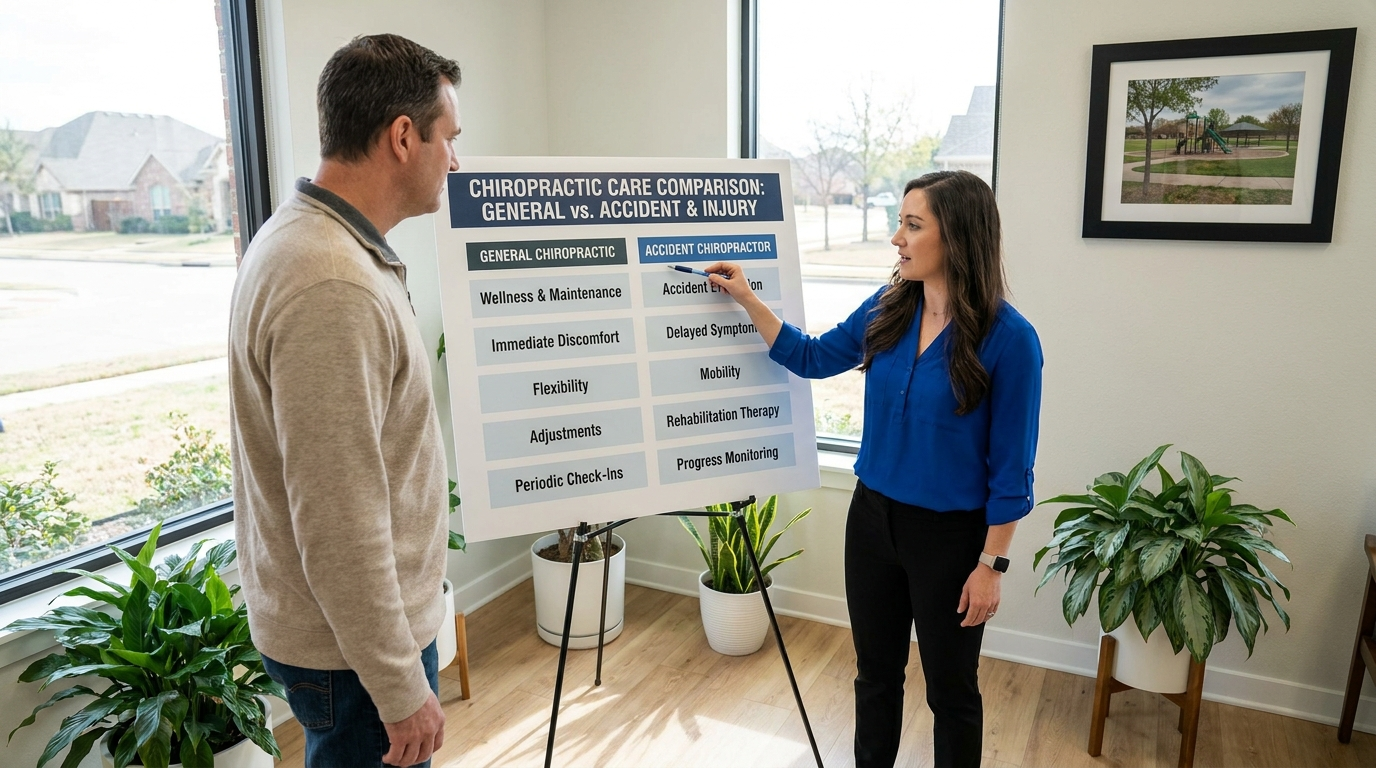

Not every chiropractic visit starts with the same problem.
Some patients visit a chiropractor for general stiffness, posture-related discomfort, wellness goals, or recurring back tension. Others visit after a car accident, truck crash, workplace incident, slip and fall, or other injury event that changed how their body feels and moves.
Those two situations can require a different kind of evaluation.
After an accident, symptoms may appear immediately or develop hours or days later. Neck pain may show up after sleep. Back pain may become noticeable while driving or sitting. Headaches may begin after the first day. Shoulder pain, knee pain, soft tissue soreness, numbness, tingling, stiffness, or reduced mobility may appear gradually.
That is where an accident-focused approach matters.
For patients looking for an accident chiropractor in Farmers Branch, Premier Injury Clinics of DFW provides accident-focused chiropractic care, same-day evaluations when available, rehabilitation therapy, structured recovery plans, progress monitoring, and transportation assistance for qualifying patients.
Quick Answer
An accident chiropractor differs from a general chiropractor because the visit is centered on accident-related symptoms, delayed pain patterns, injury mechanism, mobility limitations, soft tissue concerns, rehabilitation needs, and recovery progress after a crash or injury event.
A general chiropractor may focus on routine chiropractic concerns such as stiffness, posture-related discomfort, recurring tension, or general mobility goals.
An accident chiropractor may focus more specifically on:
- What happened during the accident
- When symptoms appeared
- Whether symptoms were delayed
- Whether neck pain, back pain, headaches, stiffness, soreness, numbness, tingling, or reduced mobility developed
- How symptoms affect driving, work, sleep, walking, sitting, standing, bending, and lifting
- Whether chiropractic care, rehabilitation therapy, soft tissue support, mobility exercises, or additional evaluation may be appropriate
- How recovery should be monitored over time
The U.S. Department of Transportation describes post-crash care as part of a safer response after serious crashes. Emergency care should always come first for serious or worsening symptoms.
Key Takeaways
- A general chiropractor and an accident chiropractor may both provide chiropractic care, but the evaluation focus can be different.
- Accident chiropractic care looks closely at crash-related symptoms, delayed pain, mobility limits, and recovery progress.
- Symptoms after an accident may include neck pain, back pain, whiplash symptoms, headaches, stiffness, soreness, soft tissue discomfort, joint pain, numbness, tingling, and reduced range of motion.
- Rehabilitation therapy may be part of accident recovery when strength, flexibility, stability, and daily function are affected.
- Emergency red flags should always be handled through emergency medical care first.
- Local Farmers Branch care may help patients near Carrollton, Addison, Irving, Las Colinas, North Dallas, and surrounding Dallas County communities stay consistent with follow-up.
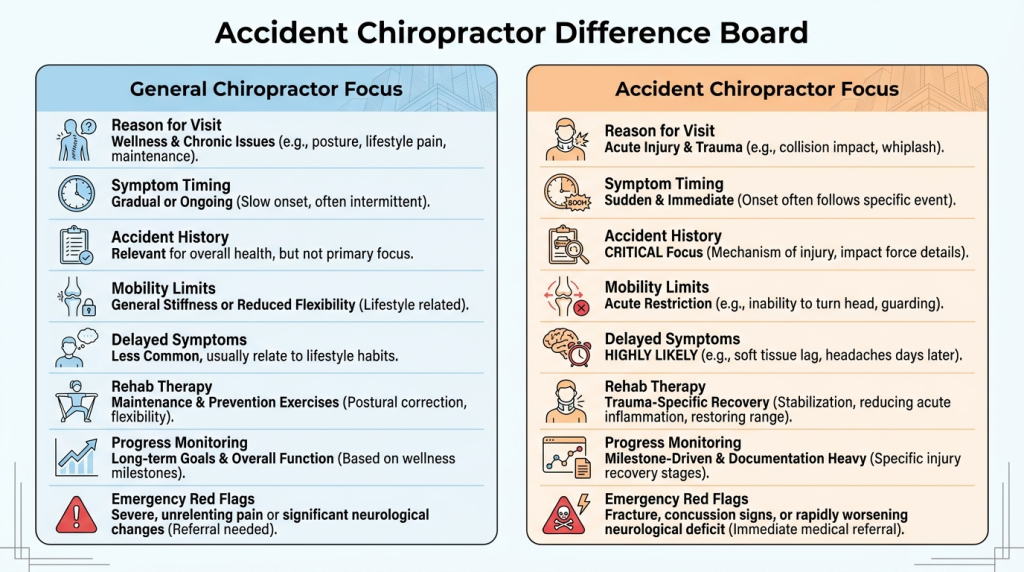
The Accident Chiropractor Difference Board
The biggest difference is not only the title.
It is the clinical focus.
| Care Area | General Chiropractor Focus | Accident Chiropractor Focus |
| Reason for visit | General stiffness, wellness, recurring discomfort, posture-related issues | Pain or movement changes after a crash or injury event |
| Symptom timing | Current discomfort and routine movement patterns | Immediate and delayed symptoms after trauma |
| Evaluation focus | Spinal movement, posture, mobility, recurring pain areas | Accident history, symptom timing, mobility limits, soft tissue concerns, daily function |
| Common symptoms | Back tension, neck stiffness, general joint discomfort | Whiplash symptoms, neck pain, back pain, headaches, soreness, numbness, tingling |
| Daily activity review | General lifestyle and movement habits | Driving, work, sleep, walking, sitting, standing, lifting, and post-accident function |
| Rehab planning | May or may not be included | Often important when strength, flexibility, stability, or function is affected |
| Progress tracking | General symptom improvement | Recovery changes after injury and activity-based progress |
| Emergency awareness | General safety screening | Strong emphasis on red flags after trauma |
This comparison does not mean one type of chiropractor is “better” in every situation. It means the right fit depends on why the patient is seeking care.
Why Accident History Changes the Evaluation
After an accident, the provider needs to understand how the body may have been affected by impact, bracing, sudden movement, or restraint.
An accident-focused evaluation may ask:
- What type of accident happened?
- When did symptoms begin?
- Did pain appear immediately or later?
- Was the body turned, braced, or twisted?
- Did the seatbelt or airbag affect the body?
- Is driving uncomfortable?
- Is sleep affected?
- Is work harder because of pain or stiffness?
- Is there numbness, tingling, weakness, or radiating discomfort?
- Are symptoms improving, worsening, or shifting?
These details help connect symptoms to movement and daily function.
Delayed Symptoms Are a Major Difference
One of the most important differences after an accident is symptom timing.
With general discomfort, a patient may already know the pattern. The back tightens after long desk work. The neck feels stiff after poor sleep. The shoulders get tense after stress.
After an accident, symptoms can be less predictable.
A person may feel fine at the scene but develop symptoms later because of stress, adrenaline, muscle tightening, soft tissue irritation, and gradual inflammation.
Delayed symptoms may include:
- Neck pain
- Back pain
- Headaches
- Whiplash symptoms
- Shoulder pain
- Knee pain
- Soft tissue soreness
- Joint discomfort
- Stiffness
- Muscle tightness
- Numbness
- Tingling
- Reduced range of motion
- Pain while driving, sitting, standing, walking, sleeping, or working
An accident chiropractor should understand that delayed symptoms can still matter, especially when they affect normal movement.
Whiplash and Neck Pain After an Accident
Whiplash is one of the most common concerns after a car accident.
Mayo Clinic explains that whiplash can happen when the neck moves forcefully and rapidly back and forth.
Whiplash-related symptoms may include:
- Neck pain
- Neck stiffness
- Headaches
- Shoulder or upper back discomfort
- Reduced range of motion
- Tingling or numbness
- Dizziness
- Tiredness
Neck symptoms can affect:
- Driving
- Checking blind spots
- Sleeping
- Desk work
- Looking down at a phone
- Lifting
- Exercise
- Normal posture
Because whiplash symptoms may appear within days, neck pain and stiffness after a crash should be monitored carefully.
Back Pain After a Crash
Back pain after an accident may involve muscle strain, spinal joint irritation, inflammation, soft tissue injury, or another injury pattern.
May affect:
- Sitting
- Standing
- Walking
- Bending
- Lifting
- Driving
- Sleeping
- Getting in and out of a vehicle
- Returning to work duties
An accident chiropractor may evaluate how the back responds to movement and daily activity, not only whether pain is present at rest.
MedlinePlus provides general guidance on returning to work with back pain, including the importance of considering job demands and discussing activity needs with a healthcare provider.
Soft Tissue Symptoms Need Attention
Accidents often affect soft tissues, including muscles, ligaments, and tendons.
Soft tissue symptoms may include:
- Soreness
- Tenderness
- Swelling
- Tightness
- Bruising
- Muscle spasms
- Reduced flexibility
- Pain with movement
- Limited range of motion
These symptoms may not always be obvious immediately. They may become more noticeable when the patient returns to normal activity.
An accident chiropractor may include soft tissue symptoms in the evaluation and recovery plan.
Joint Pain and Bracing Injuries
During a crash, many people brace without thinking.
They may grip the steering wheel, press into the floorboard, tighten the shoulders, lock the elbows, or tense the legs.
This can contribute to pain in areas such as:
- Shoulders
- Wrists
- Hands
- Hips
- Knees
- Ankles
- Upper back
- Lower back
Joint pain after an accident should be evaluated if it continues, worsens, or affects walking, lifting, driving, or daily routines.
An Accident Chiropractor Looks at Function
Pain location matters, but function matters too.
A patient may say:
- “My neck hurts.”
- “My back is sore.”
- “I have headaches.”
- “My knee feels stiff.”
An accident-focused evaluation should go deeper and ask:
- Can you turn your head while driving?
- Can you sit through a commute?
- Can you sleep through the night?
- Can you stand after sitting?
- Can you walk comfortably?
- Can you lift normal items?
- Can you return to work duties?
- Can you bend, reach, or carry without increased pain?
This functional review helps show how symptoms are affecting real life.
What an Accident-Focused First Visit May Include
An accident chiropractic evaluation may include:
- Discussion of the accident
- Review of when symptoms started
- Pain location review
- Neck and back mobility checks
- Range-of-motion review
- Soft tissue symptom discussion
- Pain and tenderness assessment
- Functional movement screening
- Review of driving, sleep, work, and daily activity limitations
- Treatment recommendations
- Recovery plan discussion
- Progress-monitoring plan
The goal is to understand how the accident affected the body and whether chiropractic care, rehabilitation therapy, mobility exercises, soft tissue support, or additional evaluation may be appropriate.
Why Rehabilitation Therapy May Be More Common After Accidents
General chiropractic care may focus on comfort, mobility, and recurring movement concerns.
Accident recovery often requires additional attention to function.
Rehabilitation therapy may help patients improve:
- Mobility
- Flexibility
- Strength
- Stability
- Movement control
- Daily activity tolerance
- Return-to-activity confidence
Rehab may include:
- Guided mobility exercises
- Stretching
- Strengthening
- Stability work
- Movement retraining
- Functional movement support
- Progressive activity planning
The goal is not to rush recovery. The goal is to help patients move forward safely and consistently.
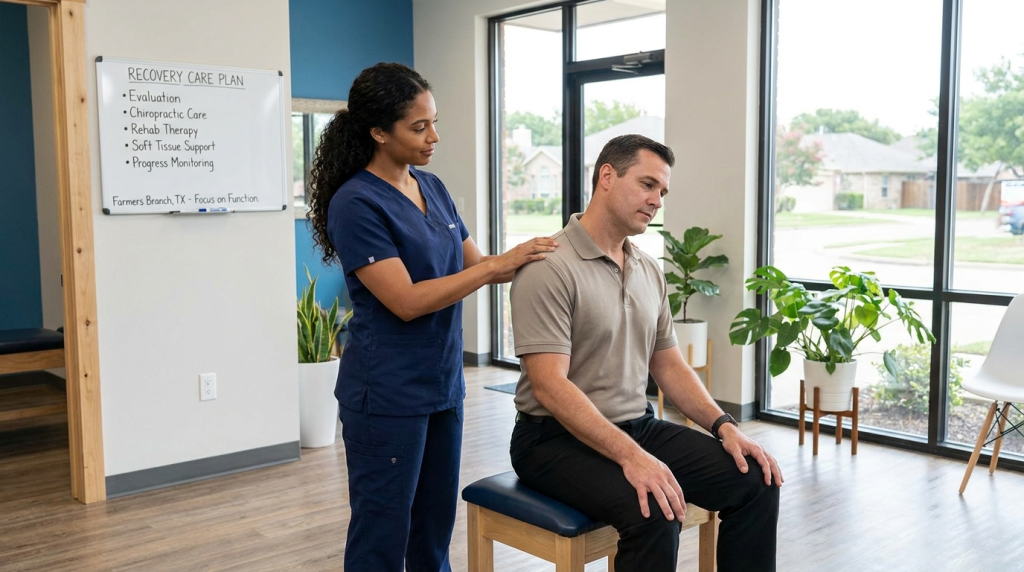
Chiropractic Care Plus Recovery Planning
An accident chiropractor may also focus on structured recovery planning.
A structured plan may include:
- Initial evaluation
- Symptom tracking
- Chiropractic care when appropriate
- Rehabilitation therapy when appropriate
- Soft tissue support
- Mobility-focused exercises
- Activity guidance
- Progress monitoring
- Care plan adjustments as symptoms change
This matters because accident recovery is not always linear.
A patient may feel better one week, then notice symptoms during work, driving, or exercise. Progress monitoring helps keep care connected to real movement.
When a General Chiropractor May Be a Good Fit
A general chiropractor may be appropriate for many non-accident concerns, such as:
- Routine stiffness
- General spinal mobility
- Posture-related discomfort
- Recurring tension
- Mild non-traumatic aches
- Wellness-focused movement goals
- Non-emergency back or neck discomfort not connected to a crash
For some patients, general chiropractic care may be exactly what they need.
The key is choosing care that matches the situation.
If the symptoms began after an accident, especially with delayed pain, headaches, numbness, tingling, reduced mobility, or daily function problems, an accident-focused evaluation may be more appropriate.
When an Accident Chiropractor May Be a Better Fit
An accident chiropractor may be a better fit when symptoms appear after:
- Car accidents
- Truck accidents
- Motorcycle accidents
- Pedestrian accidents
- Bicycle accidents
- Work accidents
- Slip and falls
- Other injury events
Consider an accident-focused evaluation if you develop:
- Neck pain
- Back pain
- Whiplash symptoms
- Headaches
- Stiffness
- Soft tissue soreness
- Shoulder pain
- Knee pain
- Joint discomfort
- Numbness
- Tingling
- Reduced mobility
- Pain while driving, working, sleeping, walking, sitting, standing, bending, or lifting
If symptoms are severe or worsening, emergency care should come first.
Farmers Branch Local Access After an Accident
Local access can matter because accident recovery may involve more than one visit.
Premier Injury Clinics of DFW’s Farmers Branch location is at:
4051 Lyndon B. Johnson Suite 190
Farmers Branch, TX 75244
The Farmers Branch clinic serves patients from:
- Farmers Branch
- Carrollton
- Addison
- Irving
- Las Colinas
- North Dallas
- Surrounding Dallas County communities
- Nearby DFW areas
This location may be helpful for patients near:
- I-635
- Dallas North Tollway
- I-35E
- Belt Line Road
- Midway Road
- Valley View Lane
- Carrollton
- Addison
- Las Colinas
- North Dallas
Transportation assistance may be available for qualifying patients recovering after an accident.
Accident Chiropractor vs General Chiropractor Checklist
Use this checklist to decide what kind of chiropractic visit may fit your situation.
| Question | General Chiropractor May Fit | Accident Chiropractor May Fit |
| Did symptoms begin after a crash or injury event? | Not usually the main focus | Yes |
| Did pain appear hours or days later? | Maybe | Yes, delayed symptoms are important |
| Do you have whiplash symptoms? | Maybe | Yes |
| Is driving affected? | Maybe | Yes, driving function should be reviewed |
| Are work or daily activities harder? | Maybe | Yes, function should be part of the plan |
| Do you need rehab therapy? | Maybe | Often useful after accident-related injuries |
| Are symptoms changing week to week? | Maybe | Yes, progress monitoring is important |
| Are there emergency warning signs? | Emergency care first | Emergency care first |
This table is not a diagnosis. It is a practical comparison to help patients ask better questions.
Questions to Ask Before Scheduling
Before choosing care, ask:
- Do you evaluate accident-related neck pain and back pain?
- Do you assess whiplash symptoms?
- Do you check range of motion and mobility?
- Do you ask how symptoms affect driving, work, sleep, and daily life?
- Do you provide rehabilitation therapy?
- How do you monitor progress?
- What should I bring to the first visit?
- What symptoms require emergency care first?
- Is transportation assistance available for qualifying patients?
- Do you serve Farmers Branch and nearby communities?
Clear questions can help patients choose care that matches their needs.
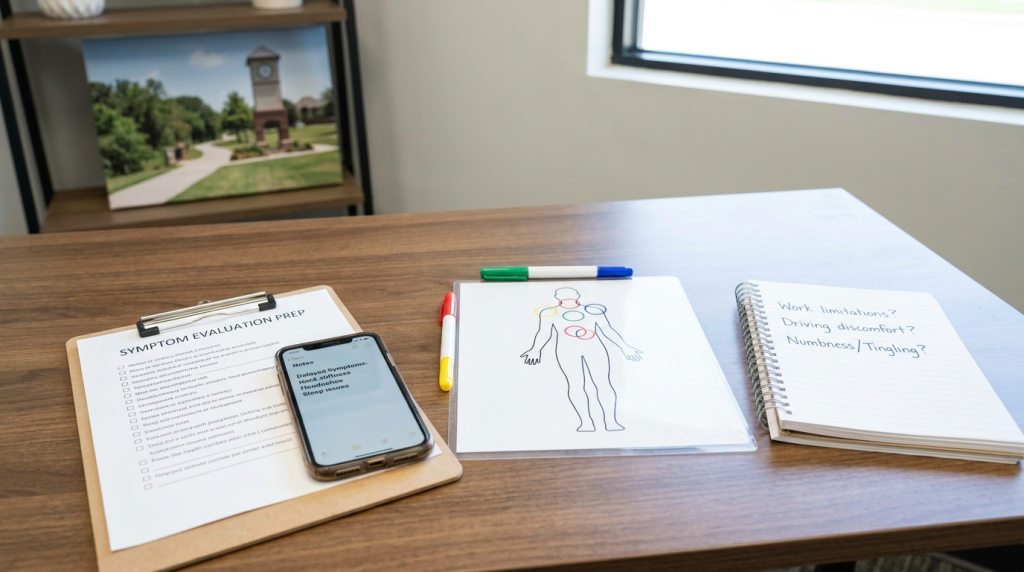
First-Visit Preparation Checklist
Use this checklist before an accident-focused chiropractic evaluation.
| Bring or Prepare | Why It Helps |
| Symptom notes | Helps explain where pain is and when it started |
| Accident details | Date, general impact direction, seat position, and airbag deployment may matter |
| Daily activity notes | Shows whether driving, work, sleep, walking, or lifting are affected |
| Prior care records | ER, urgent care, imaging, or discharge paperwork may help the evaluation |
| Medication list | Helps the provider understand what the patient is already using |
| Transportation question | Ask whether transportation assistance may be available |
| Provider questions | Helps patients remember concerns during the visit |
| Symptom changes | Helps track whether pain is improving, worsening, or shifting |
Even a short note on your phone can make the first visit clearer.
Red Flags: When to Seek Emergency Care
Chiropractic care and rehabilitation therapy may help many accident-related musculoskeletal symptoms, but some symptoms require emergency medical attention.
Seek emergency care immediately if you experience:
- Loss of consciousness
- Chest pain
- Trouble breathing
- Severe or worsening headache
- Confusion
- Repeated vomiting
- Weakness on one side of the body
- Slurred speech
- Heavy bleeding
- Severe abdominal pain
- Severe neck or back pain after trauma
- Numbness or weakness in the arms or legs
- Loss of bladder or bowel control
- Seizure
- Unequal pupils
- Unusual behavior after head trauma
The CDC lists danger signs after a possible traumatic brain injury or concussion, including worsening headache, repeated vomiting, weakness, numbness, seizures, slurred speech, confusion, unusual behavior, unequal pupils, and loss of consciousness.
When in doubt, choose emergency care first. Once serious conditions are ruled out, accident-focused chiropractic care and rehabilitation may be part of the recovery process.
Frequently Asked Questions
An accident chiropractor is a chiropractor who focuses on evaluating and supporting recovery from accident-related musculoskeletal symptoms such as neck pain, back pain, whiplash symptoms, headaches, stiffness, soft tissue soreness, joint pain, numbness, tingling, and reduced mobility.
An accident chiropractor focuses more closely on accident history, delayed symptoms, injury-related mobility limits, soft tissue concerns, daily function, rehabilitation therapy, and progress monitoring after a crash or injury event.
Consider an accident-focused evaluation if you develop neck pain, back pain, headaches, stiffness, soreness, numbness, tingling, joint pain, soft tissue discomfort, or reduced mobility after a car accident.
Yes. Symptoms may appear hours or days after a crash. Delayed symptoms may include neck pain, back pain, headaches, stiffness, soreness, soft tissue discomfort, joint pain, numbness, tingling, and reduced mobility.
An accident chiropractor may evaluate accident history, symptom timing, pain location, range of motion, neck and back mobility, soft tissue tenderness, functional movement, and daily activity limitations.
Chiropractic care may help evaluate whiplash-related symptoms such as neck pain, stiffness, headaches, shoulder discomfort, reduced range of motion, and muscle tightness. Rehabilitation therapy and progress monitoring may also be part of care.
Rehabilitation therapy may help support mobility, flexibility, strength, stability, and daily function after an accident injury. It can help patients gradually return to normal activities.
Bring symptom notes, prior urgent care or ER paperwork if available, medication details, accident details, and notes about how symptoms affect driving, work, sleep, walking, lifting, sitting, or standing.
Premier Injury Clinics of DFW’s Farmers Branch location serves Farmers Branch, Carrollton, Addison, Irving, Las Colinas, North Dallas, surrounding Dallas County communities, and nearby DFW areas.
Seek emergency care first for serious or worsening symptoms, including loss of consciousness, chest pain, trouble breathing, severe headache, confusion, repeated vomiting, weakness, slurred speech, numbness, severe neck or back pain after trauma, or loss of bladder or bowel control.
Final Thoughts
An accident chiropractor is different from a general chiropractor because the focus of care changes after a crash or injury event.
After an accident, the provider needs to understand what happened, when symptoms started, whether symptoms were delayed, how movement changed, and how pain affects daily life. Chiropractic care may be part of the plan, but accident recovery may also involve rehabilitation therapy, soft tissue support, mobility exercises, progress monitoring, and careful red-flag awareness.
Premier Injury Clinics of DFW’s Farmers Branch location provides accident-focused chiropractic care, rehabilitation therapy, same-day evaluations when available, structured recovery plans, progress monitoring, and transportation assistance for qualifying patients.
Visit the Premier Injury Clinics of DFW Farmers Branch location page to learn more about accident chiropractic care, injury evaluations, rehabilitation therapy, and recovery support in Farmers Branch.