
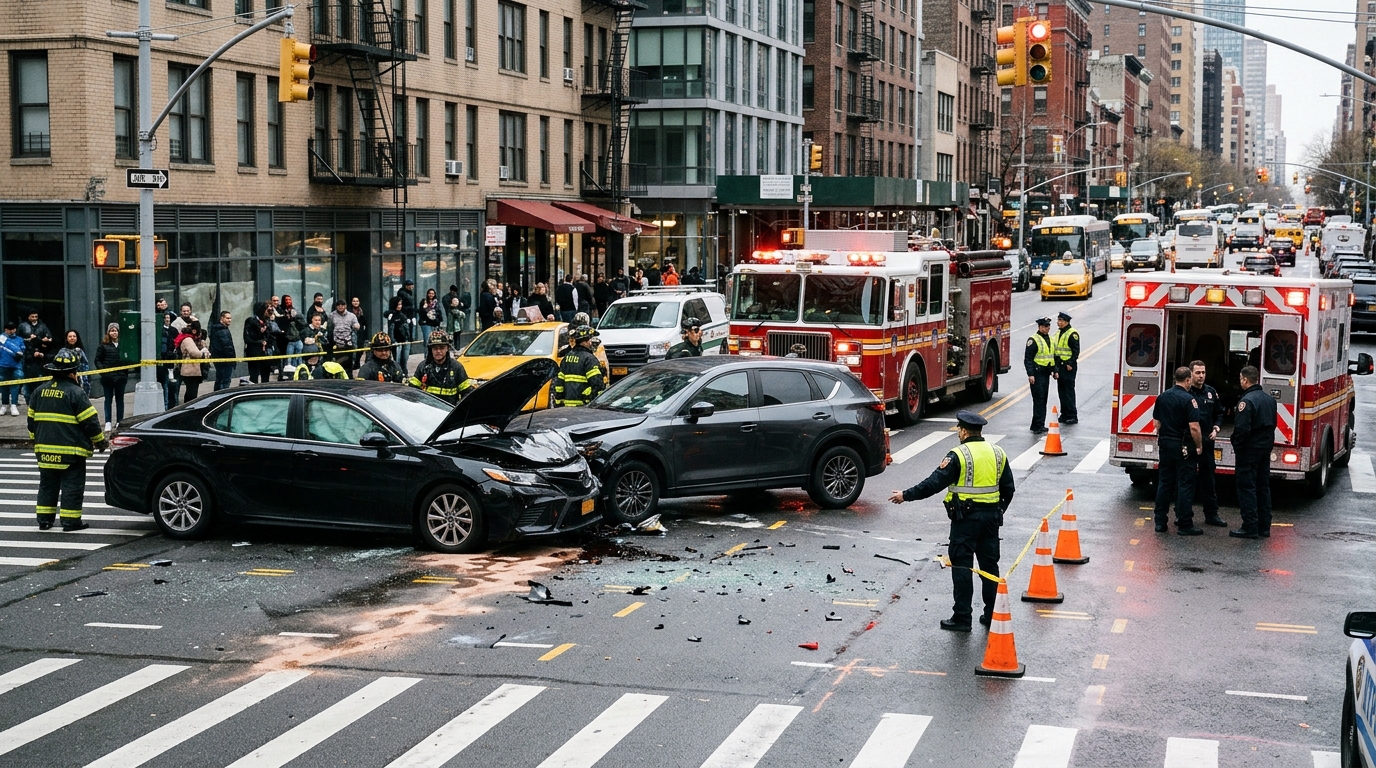

When an Uber or Lyft driver causes a serious crash in New York, injured passengers, motorists, pedestrians, and other affected individuals may pursue compensation through applicable insurance policies and personal injury claims. The outcome depends on the driver’s negligence, their status within the rideshare application, the insurance rules governing the trip, and the severity of the resulting injuries.
Serious rideshare crashes can involve several insurance carriers, substantial medical expenses, and disputed responsibility. Understanding how these claims work can help injured individuals identify the appropriate insurance coverage, preserve accident evidence, and protect their legal rights.
Quick Answer: Who Is Responsible When a Rideshare Driver Causes a Crash?
A negligent rideshare driver may be legally responsible for injuries caused by a collision. The insurance policy responding to the accident depends on the applicable regulatory framework and the driver’s activity.
Key considerations include:
- Driver Negligence: Whether the rideshare driver caused the collision through speeding, distraction, unsafe driving, or another negligent act.
- App Status: Whether the driver was offline, waiting for a passenger request, traveling to a pickup, or transporting a passenger.
- Insurance Coverage: Whether personal, transportation network company, or commercial for-hire insurance applies.
- Passenger Rights: Injured passengers may pursue qualifying insurance benefits and liability claims.
- Serious Injuries: Medical evidence helps establish treatment costs, long-term limitations, and damages.
- New York Rules: Statewide rideshare insurance requirements differ from certain New York City for-hire vehicle regulations.
A serious crash does not automatically make the rideshare platform legally liable. Responsibility must be determined using the facts, applicable insurance policies, and New York law.
What Makes a Rideshare Driver Legally Responsible for an Accident?
Rideshare drivers generally owe other road users a duty to operate their vehicles with reasonable care.
When a driver breaches that duty and causes a collision resulting in injuries, they may be liable for the resulting legally recoverable damages.
The investigation focuses on what happened before and during the collision rather than assuming liability solely because the vehicle was providing rideshare services.
Common Examples of Rideshare Driver Negligence
Rideshare accidents may occur because of unsafe conduct such as:
- Using a smartphone or navigation system while driving.
- Speeding or driving too fast for road conditions.
- Making unsafe lane changes.
- Failing to yield at intersections.
- Following vehicles too closely.
- Disregarding traffic signals.
- Driving while fatigued.
- Operating a vehicle while impaired.
- Making unsafe passenger pickups or drop-offs.
For example, a rideshare driver who looks at a phone to review an incoming trip notification may fail to notice a vehicle stopped ahead.
If that distraction causes a rear-end collision, the driver’s conduct may support a negligence claim.
Does Accepting a Ride Request Establish Negligence?
No. The act of receiving or accepting a ride request does not automatically establish liability.
Investigators must determine whether the driver’s actual conduct fell below the applicable standard of care and contributed to the accident.
A driver can be logged into a rideshare platform without being responsible for a particular collision.
Conversely, a driver who violates traffic laws or drives inattentively may be negligent regardless of whether a passenger is present.
How Is Negligence Proven?
A personal injury claim generally requires evidence of duty, breach, causation, and legally recognized damages.
Potential evidence includes:
| Evidence | Role in Establishing Negligence |
| Police Reports | Documents initial accident circumstances |
| Witness Statements | Provides independent observations |
| Dashcam Footage | May reveal driver behavior and collision sequence |
| Traffic Camera Recordings | Helps establish vehicle movements |
| Vehicle Damage | May provide information about impact dynamics |
| Electronic Records | May help establish relevant driver or trip activity |
| Medical Records | Connects documented injuries to the collision |
The available evidence must be considered collectively.
A traffic citation may be relevant, but the absence of a citation does not automatically prevent a civil negligence claim.
Which Insurance Policy Applies When a Rideshare Driver Causes a Serious Crash?
Determining insurance coverage is one of the most important steps in evaluating a rideshare accident.

Uber and Lyft drivers may operate personal vehicles under transportation network company rules or commercial vehicles regulated through a separate for-hire framework.
Coverage can change depending on the driver’s activity and applicable law.
How Rideshare App Status Changes Insurance Coverage
For qualifying transportation network company operations under New York Vehicle and Traffic Law Article 44-B, coverage varies according to whether the driver is waiting for a request or engaged in a prearranged trip.
| Driver Status | General Insurance Framework |
| App Offline | Applicable personal or commercial automobile insurance |
| App Online, Waiting for Request | TNC liability coverage with minimum limits of $75,000 per person, $150,000 per accident, and $25,000 for property damage |
| Ride Accepted, Traveling to Pickup | At least $1.25 million in required TNC liability coverage |
| Passenger Being Transported | At least $1.25 million in required TNC liability coverage |
| Qualifying NYC TLC-Regulated Operation | Separate commercial for-hire insurance requirements |
These requirements come from New York Vehicle and Traffic Law Section 1693 and related regulations.
NYSenate.gov+1
The table describes statutory minimums for qualifying statewide TNC operations. Actual policy terms and the regulatory classification of a particular vehicle must be verified.
What Happens During an Active Rideshare Trip?
Under the statewide TNC framework, a prearranged trip generally begins when a driver accepts a passenger request through the platform.
The period includes travel to the pickup location and transportation of the passenger until the trip ends under the statutory definition.
During this period, qualifying TNC operations generally require at least $1.25 million in liability coverage and applicable supplemental uninsured or underinsured motorist protection.
The existence of these limits does not guarantee that an injured person will receive $1.25 million.
Compensation depends on established liability, legally recoverable damages, available coverage, and other relevant factors.
Why New York City Insurance Rules Are Different
New York City regulates rideshare and other for-hire transportation through the Taxi and Limousine Commission.
TLC-regulated vehicles must satisfy applicable commercial insurance requirements, which differ from the ordinary Article 44-B framework.
The New York Department of Financial Services explains the distinctions between statewide TNC operations and trips originating in New York City.
Department of Financial Services
The pickup location, vehicle licensing, and governing insurance policy may therefore influence available coverage.
Can Injured Passengers Sue a Negligent Uber or Lyft Driver?
Yes. An injured rideshare passenger may pursue a qualifying personal injury claim when a driver’s negligence causes an accident.
Passengers generally have no control over the driver’s operation of the vehicle.
However, they still need to establish the necessary elements of their claim and provide evidence of their injuries and losses.
Passenger Claims Against the Rideshare Driver
A passenger may suffer injuries when a rideshare driver runs a red light, makes an unsafe turn, or collides with another vehicle.
In such circumstances, the driver’s negligence may provide the basis for a liability claim.
The applicable insurance policy depends on the vehicle’s regulatory classification and the circumstances of the ride.
Injured passengers may benefit from consulting qualified Lyft accident lawyers when the collision involves serious injuries, disputed insurance coverage, or multiple potentially responsible parties.
What If the Passenger Was Not Wearing a Seat Belt?
New York generally requires qualifying vehicle occupants to use seat belts.
Failure to wear a seat belt does not automatically establish that the passenger caused the collision.
However, the issue may become relevant to an assessment of whether certain injuries could have been reduced or prevented.
The legal significance depends on the circumstances and supporting evidence.
An insurer cannot assume that every injury resulted from seat belt nonuse.
Can Passengers Pursue Multiple Insurance Claims?
Potentially.
A rideshare crash may involve the driver’s applicable liability policy, no-fault benefits, and insurance covering another responsible motorist.
Additional uninsured or underinsured motorist coverage may be relevant when the responsible party lacks sufficient insurance.
The available claims depend on policy language, statutory requirements, and the accident circumstances.
Can the Rideshare Company Be Held Responsible?
A rideshare platform’s involvement in arranging transportation does not automatically establish direct liability for the driver’s negligence.
The question of corporate responsibility depends on the applicable legal standards and the relationship between the company and driver.
Driver Status and Company Responsibility
Rideshare companies commonly classify drivers as independent contractors.
However, contractual labels alone do not resolve every legal question concerning responsibility for an accident.
The relevant legal analysis may involve statutory requirements, the company’s conduct, and the circumstances of the transportation service.
Direct Negligence Claims
Some cases may raise questions about a company’s own conduct rather than solely the driver’s actions.
For example, allegations involving legally required screening or other statutory responsibilities may warrant investigation when supported by evidence.
Such claims are fact-specific and should not be assumed merely because a serious crash occurred.
Insurance Obligations Versus Legal Liability
It is important to distinguish between required rideshare insurance and a company’s independent liability.
A transportation network company may be required to maintain or arrange particular insurance coverage without automatically becoming legally responsible for every negligent act of a driver.
Identifying the policy that provides coverage and determining who is legally liable are related but distinct inquiries.
What Injuries Are Common in Serious Rideshare Accidents?
A serious rideshare crash may cause injuries requiring extensive medical treatment, rehabilitation, or long-term assistance.
The type and severity of injuries depend on the collision forces, seating positions, restraint use, and other circumstances.
Traumatic Brain Injuries
A traumatic brain injury may result from direct head impact or forces affecting the brain during a collision.
Symptoms can include headaches, dizziness, cognitive difficulties, confusion, and changes in memory or concentration.
Some injuries require neurological evaluation and ongoing rehabilitation.
Medical evidence is important for determining the nature of the injury and its effects on daily functioning.
Spinal and Orthopedic Injuries
Rideshare collisions may cause spinal fractures, nerve injuries, herniated discs, and other musculoskeletal conditions.
Severe injuries may require surgery, physical therapy, or long-term medical care.
Permanent limitations can affect employment, independence, and ordinary activities.
Internal Injuries and Multiple Trauma
High-impact collisions can also cause internal bleeding, organ damage, chest injuries, and multiple fractures.
Some complications may not be immediately obvious.
Prompt emergency evaluation is important when someone experiences severe pain, difficulty breathing, altered consciousness, or other concerning symptoms.
Why Serious Injury Documentation Matters
Medical records help establish the relationship between the collision and the claimed injuries.
Important evidence may include hospital records, diagnostic imaging, surgical reports, physician evaluations, and rehabilitation documentation.
For permanent injuries, expert opinions may help establish future treatment needs and functional restrictions.
How Does New York No-Fault Insurance Apply to Rideshare Crashes?
New York’s no-fault insurance system generally provides qualifying individuals with benefits for certain economic losses without requiring an initial determination of fault.
The applicable insurer depends on the vehicle’s coverage and the circumstances of the accident.
What Expenses Does No-Fault Insurance Cover?
Basic Personal Injury Protection benefits generally provide up to $50,000 per eligible person for covered economic losses.
Potential benefits include:
- Reasonable and necessary medical treatment.
- Qualifying lost earnings within statutory limits.
- Certain necessary accident-related expenses.
Coverage is subject to applicable requirements and exclusions.
The New York Department of Financial Services provides guidance about no-fault benefits and the claims process.
What Is the No-Fault Filing Deadline?
New York generally requires written notice of a no-fault claim within 30 calendar days after the accident.
Exceptions may be available when late notice is supported by an adequate explanation under the applicable regulations.
Other deadlines may apply to medical invoices and proof of lost earnings.
The no-fault notice requirement is separate from the statute of limitations governing personal injury lawsuits.
Can Serious Injury Victims Recover Pain and Suffering?
Potentially.
In qualifying motor vehicle accident claims governed by New York’s no-fault restrictions, an injured person generally must establish a statutory serious injury to recover non-economic damages.
New York Insurance Law Section 5102(d) defines qualifying categories, including certain fractures, significant disfigurement, permanent impairments, and other specified injuries.
A medically diagnosed injury does not automatically satisfy every statutory category.
The applicable threshold and available medical evidence must be evaluated individually.
What Compensation Can Victims Recover After a Serious Rideshare Crash?
Injured individuals may pursue compensation for economic and non-economic losses when the relevant legal requirements are satisfied.
The value of a claim depends on liability, injury severity, medical documentation, available insurance, and the long-term effects of the collision.
Economic Damages
Economic damages address measurable financial losses.
| Damage Category | Examples of Supporting Evidence |
| Medical Expenses | Hospital bills, specialist records, and treatment invoices |
| Lost Wages | Employer statements and payroll documentation |
| Future Medical Care | Treatment projections and physician opinions |
| Reduced Earning Capacity | Vocational assessments and employment history |
| Rehabilitation Costs | Therapy records and invoices |
| Other Eligible Expenses | Receipts and accident-related financial documentation |
Long-term injuries may create substantial financial consequences.
Future medical and employment losses generally require evidence supporting reasonable projections rather than speculation.
Non-Economic Damages
Non-economic damages address qualifying physical and personal harm.
Potential losses may include physical pain, emotional suffering, reduced enjoyment of life, and permanent limitations.
Medical records, testimony, and documentation of daily functioning can help establish the consequences.
There is no universal formula for assigning a monetary value to these losses.
Wrongful Death Claims
A fatal rideshare accident may give rise to a wrongful death claim when another party’s legally actionable conduct caused the death.
New York wrongful death claims involve separate statutory requirements governing eligible representatives, recoverable damages, and filing deadlines.
The availability of compensation depends on the facts and applicable law.
How Does Comparative Negligence Affect a Rideshare Accident Claim?
New York follows a pure comparative negligence system.
Under CPLR Section 1411, an injured person’s share of fault generally reduces recoverable damages proportionally rather than automatically preventing compensation.
Example of Comparative Fault
Suppose a rideshare collision produces $250,000 in legally recoverable damages.
The evidence establishes that the injured claimant bears 20% responsibility.
Illustrative comparative negligence calculation
Total damages
$250,000
Claimant’s fault
20%
Adjusted damages
$200,000
Hypothetical example only. Insurance policy limits, coverage provisions, and other legal rules may affect recovery.
The claimant’s $250,000 damages would generally be reduced by $50,000.
Can Multiple Drivers Share Fault?
Yes.
A crash may involve negligent actions by a rideshare driver and another motorist.
For example, one driver may make an improper turn while another contributes to the accident by speeding.
The evidence must establish each party’s relevant conduct and its contribution to the collision.
Does a Passenger Automatically Share Responsibility?
No.
A passenger is not ordinarily responsible for the driver’s negligence merely because they booked or occupied the vehicle.
Any allegation of passenger fault must be evaluated according to the actual conduct involved and the applicable law.
What Evidence Is Important When a Rideshare Driver Causes a Crash?
Serious rideshare accident claims often require conventional collision evidence together with digital records associated with the rideshare platform.

Preserving these materials can help establish negligence, insurance eligibility, and damages.
Save Rideshare App Records
Passengers should preserve available information about the trip.
Important records may include:
- Trip confirmations and receipts.
- Pickup and destination details.
- Driver identification.
- Vehicle make, model, and registration information.
- Trip date and time.
- Available route information.
- Relevant communications through the platform.
These records may help determine whether the accident occurred during a covered prearranged trip.
Preserve Physical Accident Evidence
Photographs and video may help establish the collision circumstances.
Evidence may include damaged vehicles, road conditions, skid marks, traffic signals, and visible injuries.
Available surveillance footage should be identified promptly because some recording systems retain footage for limited periods.
Obtain Witness and Police Information
Independent witnesses may describe the driver’s behavior before the collision.
Police reports can identify involved vehicles and document initial accident findings.
However, a police report is not necessarily a final determination of civil liability.
Maintain Medical and Financial Documentation
Injured individuals should preserve treatment records, medical invoices, employment documents, and relevant receipts.
Accurate records can help demonstrate the injuries and financial losses associated with the accident.
The relationship between medical findings and claimed damages may become especially important when insurers dispute injury severity or causation.
What Should Victims Do Immediately After a Serious Uber or Lyft Crash?
The steps following a rideshare collision can affect personal safety and the availability of evidence.
Medical care should always take priority over documenting the scene.
Seek Emergency Medical Assistance
Call 911 when someone is seriously injured or the collision creates an immediate hazard.
Avoid unnecessary movement when a serious neck, back, or spinal injury is suspected.
Medical professionals should evaluate symptoms and determine appropriate treatment.
Report the Accident
Notify law enforcement as required and obtain available accident report information.
Passengers may also report the collision through the rideshare platform.
Platform reporting does not replace applicable police, DMV, or insurance notification requirements.
Preserve Trip Details
Save the ride receipt, available app records, and any relevant communications.
The driver’s app status may become important in determining available insurance coverage.
Avoid Unsupported Statements About Fault
Provide accurate factual information to investigators and insurers.
Avoid guessing about collision speed, medical diagnoses, or events not directly observed.
Review Applicable Deadlines
Insurance claims and personal injury lawsuits may involve different deadlines.
Identifying those requirements early can reduce the risk of losing available legal options.
What Happens If the Insurance Company Denies or Disputes the Claim?
Insurance companies may disagree about liability, coverage, injury causation, or the amount of recoverable damages.
A denial or reduced settlement offer does not automatically establish that the insurer’s position is correct.
Disputes Over Driver App Status
An insurer may contend that the driver was offline or had not accepted a trip when the collision occurred.
This can affect which insurance provisions apply.
App records, trip confirmations, and other digital evidence may help clarify the driver’s activity.
Disputes Over Medical Causation
An insurer may argue that certain injuries were unrelated to the crash or resulted from pre-existing medical conditions.
Medical documentation and qualified opinions may help resolve such disagreements.
Disputes Over Settlement Value
Serious injuries can create substantial future expenses and long-term limitations.
An insurer may disagree with projected medical costs or diminished earning capacity.
Detailed records and expert assessments may help establish those losses.
The Uber accident attorney guide discusses additional considerations for individuals pursuing compensation after rideshare accidents.
How Long Do Victims Have to File a Rideshare Accident Lawsuit?
New York generally provides a three-year statute of limitations for ordinary negligence-based personal injury lawsuits under CPLR Section 214(5).
The period usually begins on the date of the accident, although exceptions and different deadlines may apply.
The New York Courts statute of limitations timetable provides general guidance concerning civil filing periods.
New York Courts
Can Shorter Deadlines Apply?
Yes.
Certain claims involving public entities, uninsured motorist coverage, or other specialized legal issues may involve additional notice requirements or shorter deadlines.
Wrongful death actions also have separate statutory filing requirements.
The correct deadline depends on the claim and parties involved.
Do Insurance Negotiations Pause the Deadline?
Not automatically.
An ongoing insurance investigation or settlement discussion does not necessarily extend the period for filing a lawsuit.
Claimants should evaluate insurance notice requirements and court filing deadlines separately.
When Should Victims Contact a Rideshare Accident Attorney?
Legal representation may be useful when a rideshare collision causes serious injuries, substantial financial losses, disputed negligence, or complicated insurance questions.

Cases involving permanent disability, multiple insurance carriers, or disagreement about driver app activity may require detailed investigation.
How an Attorney Can Help
Depending on the circumstances, an attorney may assist with obtaining records, evaluating applicable insurance, investigating negligence, identifying responsible parties, and assessing damages.
Complex claims may require accident reconstruction professionals, medical specialists, or financial experts.
An attorney may also assist with settlement negotiations and litigation when appropriate.
What Information Should Victims Prepare?
Helpful documents may include accident reports, ride receipts, medical records, photographs, insurance correspondence, and proof of lost income.
Preserving these materials can make it easier to evaluate the available evidence.
Individuals seeking legal guidance can contact an injury law firm near me to discuss their circumstances and potential options.
The outcome of any claim depends on its facts and applicable legal requirements.
Frequently Asked Questions
1. Who pays when an Uber or Lyft driver causes a serious accident?
The responsible insurer depends on the driver’s app status, vehicle licensing, location of the trip, and applicable insurance policy. Qualifying rideshare trips under New York’s statewide TNC framework may involve higher commercial liability coverage. New York City TLC-regulated operations follow different insurance requirements. Compensation also depends on established liability and damages.
2. Can an injured passenger sue an Uber or Lyft driver?
Yes. A passenger injured because of a rideshare driver’s negligence may pursue a qualifying personal injury claim. Available compensation may include medical expenses, lost income, and legally recoverable non-economic damages. The applicable insurance policy and New York’s no-fault requirements must be considered.
3. Is Uber or Lyft automatically liable when its driver causes a crash?
No. A rideshare company’s obligation to provide or arrange insurance does not automatically establish its direct legal liability. Claims against a platform depend on the applicable law, relevant contractual and operational relationships, and any evidence supporting independent wrongdoing.
4. Does the $1.25 million rideshare insurance requirement guarantee compensation?
No. For qualifying statewide prearranged rideshare trips, New York generally requires at least $1.25 million in liability insurance. This is a coverage limit, not a guaranteed settlement amount. The amount recoverable depends on liability, the claimant’s injuries, legally compensable losses, and other applicable conditions.
5. How long does a serious rideshare accident claim take to settle?
There is no universal timeline. Cases involving clear liability and completed medical treatment may resolve more quickly than disputes involving permanent disabilities, several insurance carriers, or litigation. Settlement timing depends on the available evidence, injury prognosis, insurance investigations, and negotiations.
Conclusion
When a rideshare driver causes a serious crash in New York, the legal and insurance consequences depend on the driver’s negligence, app status, applicable coverage, and the injuries sustained.
Passengers, other motorists, pedestrians, and rideshare drivers may have different avenues for recovering compensation. Serious claims can involve overlapping policies, disputed responsibility, and substantial future medical or financial losses.
Preserving trip records, obtaining timely medical care, investigating liability, and understanding relevant deadlines can help injured individuals protect their rights and pursue appropriate compensation under New York law.