


Maternity scrubs are designed to accommodate a changing body while maintaining the movement, coverage, and professional appearance required in healthcare work. The right maternity uniform should provide enough room through the abdomen without creating excessive fabric elsewhere. Professionals choosing maternity scrubs should consider waistband design, fabric stretch, top length, pant rise, inseam, and the amount of growth expected during pregnancy.
Key Takeaways
- Maternity scrubs should accommodate abdominal growth without making the entire garment excessively loose.
- Stretch fabric can improve comfort as body proportions change.
- Maternity pants may use different waistband constructions, including panels and adjustable designs.
- Top length matters because coverage can change as the abdomen grows.
- Petite, regular, and tall proportions should be considered when available.
- The correct maternity scrub size may differ from a pre-pregnancy size.
- Fit should be evaluated while standing, sitting, walking, bending, and reaching.
- Fabric weight and breathability become particularly important during long healthcare shifts.
- Workplace color and uniform requirements still apply during pregnancy.
- Maternity scrubs are workwear and should not be treated as a substitute for required PPE.
What Are Maternity Scrubs?
Maternity scrubs are healthcare uniforms designed to accommodate physical changes during pregnancy.
Compared with standard women’s scrubs, maternity styles may provide additional room or specialized construction around the abdomen.
Common features can include:
- Stretch panels
- Adjustable waistbands
- Elastic waist construction
- Longer scrub tops
- Additional torso room
- Flexible fabric
- Maternity-specific pant cuts
The exact design varies by manufacturer and collection.
Some maternity garments are designed specifically for pregnancy, while others use highly flexible construction that can accommodate changing body proportions.
Why Do Healthcare Professionals Need Maternity Scrubs?
Standard scrubs are generally designed around relatively stable body proportions.
Pregnancy can change:
- Abdominal size
- Waist circumference
- Hip proportions
- Bust measurements
- Overall garment length requirements
A standard scrub top or pant may therefore become uncomfortable even when the garment was previously the correct size.
Maternity-specific workwear can provide additional room in the areas most affected by pregnancy while maintaining a practical fit elsewhere.
The goal is not simply to make scrubs larger
Increasing the overall size of a standard scrub can create problems.
For example, sizing up may provide additional abdominal room but also create:
- Excess shoulder width
- Overly long sleeves
- Loose hips
- Excess fabric around the legs
- Poor pocket positioning
Maternity construction is intended to address changing proportions more specifically.
How Should Maternity Scrubs Fit During Pregnancy?
The ideal fit changes as pregnancy progresses.

Rather than looking for a perfect fit at only one point, consider how the garment is likely to perform as the body changes.
A maternity scrub should generally provide:
- Comfortable abdominal room
- Appropriate coverage
- Secure but non-restrictive waist support
- Sufficient stretch
- Practical movement
- Suitable overall length
Check the abdomen
The garment should accommodate the abdomen without creating strong pressure.
Look for:
- Excessive pulling
- Tight elastic
- Waistband digging
- Fabric riding upward
- Insufficient coverage
The garment should remain comfortable in both standing and seated positions.
Check the shoulders
Even when the abdomen is the main area of change, shoulder fit remains important.
The shoulders should allow:
- Reaching
- Lifting the arms
- Turning
- Bending
- Normal clinical movements
A garment should not be so large that the shoulder seams become poorly positioned.
How Do Maternity Scrub Pants Work?
Maternity scrub pants can use specialized waistband construction to accommodate abdominal growth.
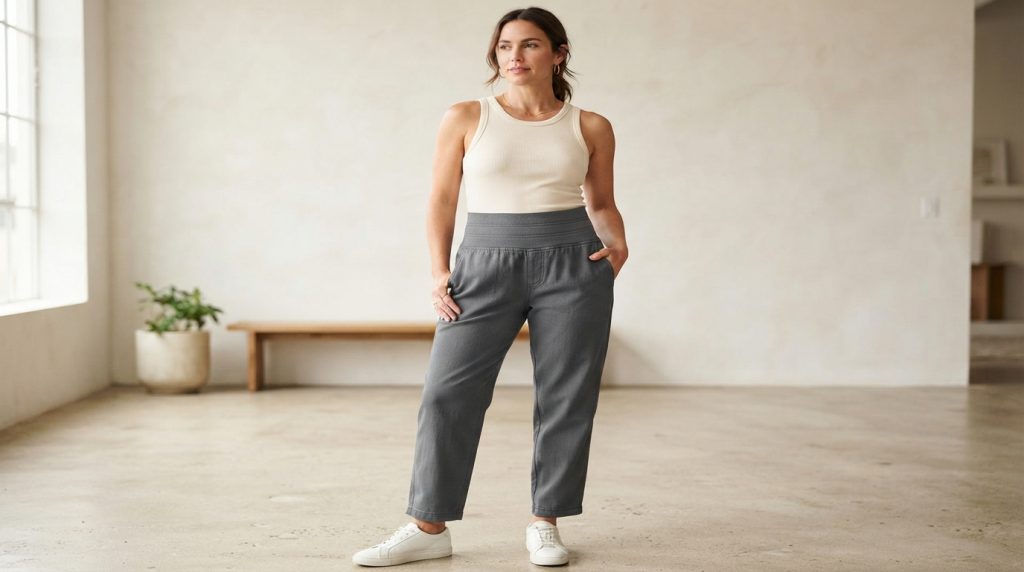
Common approaches include:
- Stretch maternity panels
- Elastic waistbands
- Adjustable waist systems
- Low-rise designs
- Higher-rise supportive designs
The best option depends on personal preference and stage of pregnancy.
Maternity panel pants
A maternity panel can provide additional stretch across the abdomen.
Depending on the design, the panel may sit:
- Below the abdomen
- Across the abdomen
- Higher over the abdomen
The important consideration is whether the panel feels comfortable during extended wear.
Adjustable waist designs
An adjustable waist can provide flexibility as body proportions change.
This can be useful when a professional wants more control over how the pants sit throughout pregnancy.
Low-rise maternity pants
Some maternity styles sit lower beneath the abdomen.
They may appeal to professionals who prefer less fabric across the stomach.
Higher-rise designs
Higher-rise maternity pants can provide additional abdominal coverage.
The preference is highly individual.
What Should the Maternity Waistband Feel Like?
The waistband should stay secure without creating uncomfortable pressure.
A common mistake is choosing a waistband that feels appropriate while standing but becomes restrictive when seated.
Test it while:
- Sitting
- Standing
- Walking
- Bending
- Reaching
- Transitioning between positions
The waistband should not repeatedly require adjustment.
Signs the waistband may be too tight
Watch for:
- Digging
- Pinching
- Red marks
- Pressure while sitting
- Difficulty bending
- Constant adjustment
Signs it may be too loose
Watch for:
- Pants sliding down
- Excessive movement
- Drawstring over-tightening
- Unstable pocket placement
The goal is secure comfort rather than maximum compression.
How Should Maternity Scrub Tops Fit?
Maternity scrub tops need to accommodate both abdominal and bust changes.
A top that fits well before pregnancy may become short or restrictive later.
Important areas include:
- Bust
- Shoulders
- Abdomen
- Hem length
- Armholes
- Sleeves
Why does top length matter?
As the abdomen grows, the front of the scrub top can appear shorter.
This can affect coverage when:
- Sitting
- Bending
- Reaching
- Walking
A maternity top with additional length or flexible construction can help maintain coverage.
Should maternity scrub tops be oversized?
Not necessarily.
Excessively oversized tops can create:
- Poor shoulder fit
- Excess fabric
- Difficult layering
- Less practical pocket placement
A maternity top should provide room where it is needed without making the entire garment excessively loose.
How Important Is Stretch in Maternity Scrubs?
Stretch can be particularly useful because body proportions change during pregnancy.
Stretch fabrics can help accommodate movement and changing measurements.
However, not all stretch behaves the same way.
Consider:
- Stretch amount
- Stretch recovery
- Fabric weight
- Fabric softness
- Garment construction
A fabric with good stretch can still feel uncomfortable if the garment is too small.
Stretch should support fit, not compensate for inadequate sizing.
What Fabric Is Best for Maternity Scrubs?
There is no universally best maternity scrub fabric.
The appropriate choice depends on:
- Workplace temperature
- Activity level
- Personal comfort
- Fabric sensitivity
- Desired care routine
- Amount of stretch needed
Common fabric characteristics include:
| Fabric Characteristic | Why It May Matter During Pregnancy |
| Stretch | Accommodates changing movement and proportions |
| Lightweight construction | May feel more comfortable in warm environments |
| Breathability | Can support comfort during extended wear |
| Soft texture | May reduce irritation |
| Durability | Useful for frequent laundering |
| Wrinkle resistance | Helps maintain a polished appearance |
| Easy care | Reduces garment-maintenance demands |
The fabric should be considered together with the garment’s construction.
How Should Petite Women Choose Maternity Scrubs?
Petite proportions can make maternity scrub selection more complicated because pregnancy changes body dimensions while height and inseam remain relatively shorter.
Important considerations include:
- Inseam
- Top length
- Sleeve length
- Shoulder width
- Rise
- Overall garment proportions
A common mistake is buying a larger standard garment simply to create additional abdominal room.
This can result in excessive length through the legs and sleeves.
Check the inseam
Maternity pants should provide enough length without creating excessive fabric around the ankle.
If petite maternity options are unavailable, check whether the regular garment has an appropriate inseam or can be professionally altered without affecting its intended construction.
Check top proportions
A maternity top can provide abdominal room without requiring excessive shoulder or sleeve length.
The goal is balanced proportions.
How Should Women With Regular Proportions Choose Maternity Scrubs?
Regular-length maternity scrubs may provide the broadest selection of styles and sizes.
Still, fit should be evaluated based on actual body measurements.
Consider:
- Bust
- Abdomen
- Hips
- Inseam
- Shoulder width
- Top length
Do not assume that a pre-pregnancy size will automatically remain appropriate.
The right size depends on the garment’s construction and the manufacturer’s current size chart.
How Should Tall Women Choose Maternity Scrubs?
Tall professionals may need additional inseam and torso length during pregnancy.
Important measurements include:
- Inseam
- Rise
- Top length
- Sleeve length
- Overall torso proportions
A standard maternity pant that fits around the abdomen may still be too short through the legs.
Similarly, a maternity top may provide sufficient abdominal width but insufficient torso length.
Avoid solving length problems by sizing up
Sizing up can add width without adding proportional length.
If tall options are available, they may provide a better overall fit.
How Should You Choose Maternity Scrub Pants by Pregnancy Stage?
Body changes differ from one person to another, so maternity uniform needs cannot be assigned strictly by trimester.

Nevertheless, different stages can create different fitting considerations.
Earlier pregnancy
Some professionals may continue wearing regular scrubs during the early stages if they remain comfortable and workplace requirements permit.
A flexible waistband or stretch fabric can provide additional comfort.
Middle pregnancy
As the abdomen grows, maternity-specific waist construction can become more useful.
Consider:
- Waistband flexibility
- Abdominal coverage
- Top length
- Overall comfort
Later pregnancy
Additional abdominal room may become increasingly important.
The garment should still provide:
- Secure fit
- Appropriate coverage
- Comfortable movement
- Practical length
There is no universal point when everyone needs maternity scrubs.
Comfort and fit should guide the transition.
Can You Wear Regular Scrubs During Pregnancy?
Some people can comfortably wear regular scrubs during part of pregnancy, depending on the garment’s construction and individual body changes.
Stretch fabrics and flexible waistbands may provide additional room.
However, regular scrubs should not be forced to fit once they become restrictive.
Potential signs that a different garment is needed include:
- Waistband pressure
- Insufficient abdominal coverage
- Tightness across the hips
- Restricted movement
- Tops riding upward
- Frequent garment adjustment
The priority is comfortable, appropriate workwear that meets workplace requirements.
How Should Maternity Scrubs Be Layered?
Healthcare professionals may wear maternity scrubs with:
- Underscrub shirts
- Scrub jackets
- Lab coats
- Other approved outer layers
Layering can become more complicated as pregnancy progresses.
Test the complete uniform
If a jacket or lab coat is part of the normal work uniform, try it over the maternity scrub top.
Check:
- Shoulder room
- Bust room
- Abdominal room
- Sleeve length
- Overall closure
A coat that fits over a standard scrub top may not fit comfortably over a maternity top.
Professionals considering women’s lab coats should evaluate the complete layered uniform rather than purchasing the outer garment independently.
How Important Are Pockets in Maternity Scrubs?
Pocket placement remains important during pregnancy.
As the abdomen changes, pockets may sit differently on the body.
Evaluate whether pockets remain:
- Accessible
- Comfortable
- Secure
- Appropriately positioned
Heavy pocket contents can also affect how the garment hangs.
Choose storage according to actual work needs
Consider what is normally carried during the workday.
Avoid choosing maternity scrubs solely because they have the greatest number of pockets.
Useful pocket placement is more important than pocket quantity.
How Should Maternity Scrubs Fit for Nurses?
Nurses may spend much of a shift walking, standing, bending, reaching, and assisting patients.
Maternity scrubs should therefore support:
- Comfortable movement
- Abdominal room
- Secure waist fit
- Practical storage
- Appropriate coverage
- Easy-care performance
Nurses should test maternity garments while performing realistic movements rather than simply standing.
Consider workplace requirements
A healthcare facility may establish specific:
- Colors
- Styles
- Department requirements
- Dress codes
- PPE procedures
Pregnancy does not necessarily change these requirements unless the organization has specific accommodations or policies.
What Should Pregnant Medical Assistants Consider?
Medical assistants may alternate between clinical and administrative tasks.
They may:
- Prepare patients
- Take measurements
- Assist providers
- Walk between rooms
- Sit for documentation
This combination makes both standing and seated comfort important.
Maternity pants should remain comfortable while sitting, and the top should provide appropriate coverage during movement.
What Should Pregnant Healthcare Students Consider?
Healthcare students may move between classrooms, laboratories, clinical rotations, and patient-facing environments.
Maternity scrubs may need to work across multiple settings.
Important considerations include:
- School uniform requirements
- Clinical-site requirements
- Color restrictions
- Fit
- Layering
- Durability
- Easy care
Students should confirm requirements before purchasing multiple sets.
How Should You Choose Maternity Scrub Sizes?
Maternity sizing is not always identical to standard women’s scrub sizing.
Always review the specific manufacturer’s size chart.
Consider:
- Current measurements
- Expected garment stretch
- Intended maternity fit
- Pregnancy stage
- Garment construction
Do not automatically buy several sizes larger than the pre-pregnancy size.
The goal is additional room in the areas where the garment is designed to accommodate pregnancy while preserving appropriate proportions elsewhere.
Should You Buy Maternity Scrubs in Advance?
Planning ahead can be useful because body changes are difficult to predict precisely.
However, buying an excessive number of garments too early may not be practical if the preferred size or fit changes.
A reasonable approach is to:
- Confirm workplace requirements
- Identify the garments most likely to be needed
- Purchase enough for normal uniform rotation
- Reassess fit as pregnancy progresses
- Add garments when necessary
This can reduce the risk of accumulating clothing that becomes unsuitable later.
How Many Maternity Scrub Sets Do You Need?
There is no universal number.
The appropriate quantity depends on:
- Number of shifts per week
- Laundry frequency
- Workplace requirements
- Backup needs
- Pregnancy stage
A professional who works several shifts between laundry cycles may need more sets than someone who launders uniforms frequently.
Consider the actual work schedule rather than following a fixed number.
How Should Maternity Scrubs Be Cared For?
Always follow the specific garment’s care label.
Maternity scrubs can include stretch panels, elastic components, and blended fabrics that may have specific care requirements.
Check:
- Washing temperature
- Drying instructions
- Bleaching restrictions
- Ironing instructions
- Special-care warnings
The Federal Trade Commission’s Care Labeling Rule provides requirements concerning care instructions for covered apparel.
Following the garment’s care instructions can help maintain its shape and performance.
Common Maternity Scrub Shopping Mistakes
Buying a standard scrub size several sizes larger
This can provide extra abdominal space but create poor proportions elsewhere.
Ignoring the waistband
A waistband can feel acceptable while standing but become uncomfortable when sitting.
Forgetting top length
As the abdomen grows, a standard scrub top can become shorter in front.
Ignoring inseam
Petite and tall proportions require different length considerations.
Choosing fabric based only on stretch
Stretch matters, but fabric weight, construction, and overall fit also affect comfort.
Buying too many sets too early
Body proportions can change throughout pregnancy.
Ignoring workplace requirements
Color and style requirements still need to be considered.
Treating maternity scrubs as protective equipment
Scrubs are workwear. They do not automatically replace task-specific PPE.
Maternity Scrub Buying Checklist
Before purchasing maternity scrubs, check:
- Abdomen: Is there sufficient room without excessive pressure?
- Waistband: Does it remain comfortable while sitting?
- Top length: Does it maintain appropriate coverage?
- Shoulders: Can the arms move naturally?
- Bust: Does the top close or sit comfortably?
- Hips: Is there enough room without excessive looseness?
- Inseam: Is the length appropriate for petite, regular, or tall proportions?
- Fabric: Is the weight and texture suitable for the workplace?
- Stretch: Does the garment accommodate normal movement?
- Pockets: Are they practical and accessible?
- Layers: Does the outfit work with jackets or lab coats?
- Care: Are the laundering instructions practical?
- Workplace: Does the uniform meet facility requirements?
Professionals who want to assess different scrub fabrics, sizes, and layering options in person can also visit a medical uniform store in Wilmington.
Final Thoughts
Maternity scrubs are designed to address one of the most important challenges of healthcare work during pregnancy: maintaining a practical, professional uniform while body proportions change.
The best maternity uniform does not simply provide more fabric. It places additional room and flexibility where they are needed while maintaining appropriate proportions through the shoulders, sleeves, hips, legs, and overall garment length.
For pants, the waistband, rise, abdominal coverage, inseam, and leg shape deserve particular attention. For tops, bust room, shoulder mobility, torso length, and neckline coverage become increasingly important.
Petite, regular, and tall professionals may have different length requirements, and buying a larger standard size is not always an effective solution. When available, maternity garments designed around different proportions can provide a more balanced fit.
Fabric and stretch are also important, particularly during long shifts. However, stretch should support proper sizing rather than compensate for a garment that is otherwise too restrictive.
Finally, workplace requirements should guide the selection. Healthcare organizations can have specific color, style, infection-control, and PPE policies, so a comfortable maternity garment still needs to be appropriate for the environment in which it will be worn.
Frequently Asked Questions
When should you start wearing maternity scrubs?
There is no universal point when every healthcare professional needs maternity scrubs. Some can remain comfortable in regular stretch scrubs during part of pregnancy, while others may need additional room earlier. Switch when standard garments become restrictive, uncomfortable, or insufficient for appropriate coverage.
Should you size up in maternity scrubs?
Not necessarily. Maternity scrubs are designed to accommodate pregnancy through their construction, so buying several sizes larger than normal can create excessive room in the shoulders, sleeves, hips, or legs. Use the specific maternity garment’s size chart and intended fit.
Are maternity scrub pants better than regular scrub pants during pregnancy?
Maternity scrub pants can provide specialized abdominal room and waistband construction that regular pants may not offer as the pregnancy progresses. However, some professionals may remain comfortable in flexible regular scrubs for part of pregnancy. Fit and comfort should determine when a change is needed.
What should pregnant nurses look for in maternity scrubs?
Pregnant nurses should consider abdominal room, waistband comfort, stretch, top length, movement, pocket placement, fabric weight, and workplace requirements. Because nursing can involve frequent walking, bending, and reaching, the complete uniform should be tested under realistic movement.
Do maternity scrubs come in petite and tall sizes?
Availability varies by manufacturer and collection. When petite or tall maternity options are unavailable, pay particular attention to inseam, top length, sleeve length, and overall proportions rather than simply sizing up or down.