
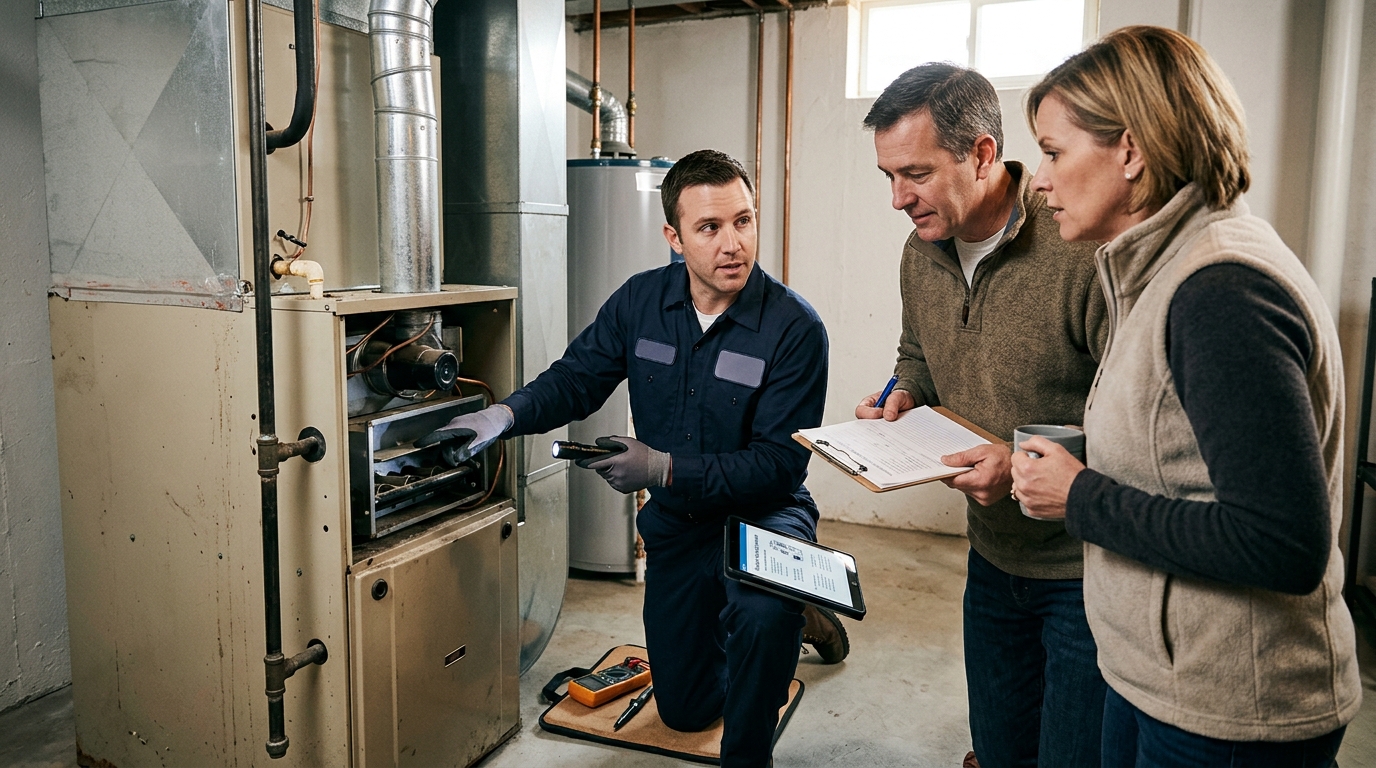

When a furnace develops a problem, homeowners often face an important decision: repair the existing equipment or replace it with a new system.
A minor repair on a relatively young, well-maintained furnace can be a straightforward choice. The decision becomes more complicated when an older furnace requires an expensive repair, experiences repeated breakdowns, or no longer heats the home efficiently.
For Michigan homeowners, the stakes can be particularly high. A dependable heating system is essential during extended periods of freezing weather, so reliability should be considered alongside the immediate cost of a repair.
There is no single furnace age or repair price that automatically determines the correct answer. A better decision comes from evaluating the furnace’s age, condition, repair history, efficiency, safety, comfort performance, and expected future costs.
Homeowners considering furnace replacement should therefore compare the total long-term cost of keeping the existing furnace with the cost and potential benefits of installing newer equipment.
Quick Answer
Furnace repair is usually the better option when the equipment is relatively young, has been reliable, and needs a reasonably priced repair. Furnace replacement becomes more attractive when an older system requires frequent or expensive repairs, has declining efficiency, struggles to heat the home consistently, or develops a major safety-related problem.
The decision should be based on the overall condition and expected future cost of the furnace—not age alone.
Key Takeaways
- A single furnace problem does not automatically justify replacement.
- Minor repairs can extend the useful life of otherwise healthy equipment.
- Furnace age becomes more important when combined with repeated problems.
- Frequent repairs can make replacement financially more attractive.
- Declining efficiency may increase the long-term cost of keeping an older furnace.
- Safety concerns deserve greater weight than repair cost alone.
- Correct furnace sizing matters when replacement becomes necessary.
- A professional inspection can help distinguish an isolated repair from broader equipment deterioration.
Why the Repair-or-Replace Decision Can Be Difficult
A furnace contains numerous components, and they do not all wear out simultaneously.
A relatively inexpensive component can fail even when the rest of the furnace remains in excellent condition. Conversely, repairing one component in an aging furnace may simply be followed by another failure several months later.
That is why homeowners should avoid making the decision based exclusively on the component that failed.
A more complete evaluation considers:
- Furnace age
- Maintenance history
- Current repair cost
- Previous repair expenses
- Heating performance
- Energy consumption
- Safety
- Parts availability
- Expected remaining service life
Together, these factors provide a more realistic picture of whether additional investment in the existing furnace makes financial sense.
When Furnace Repair Usually Makes Sense
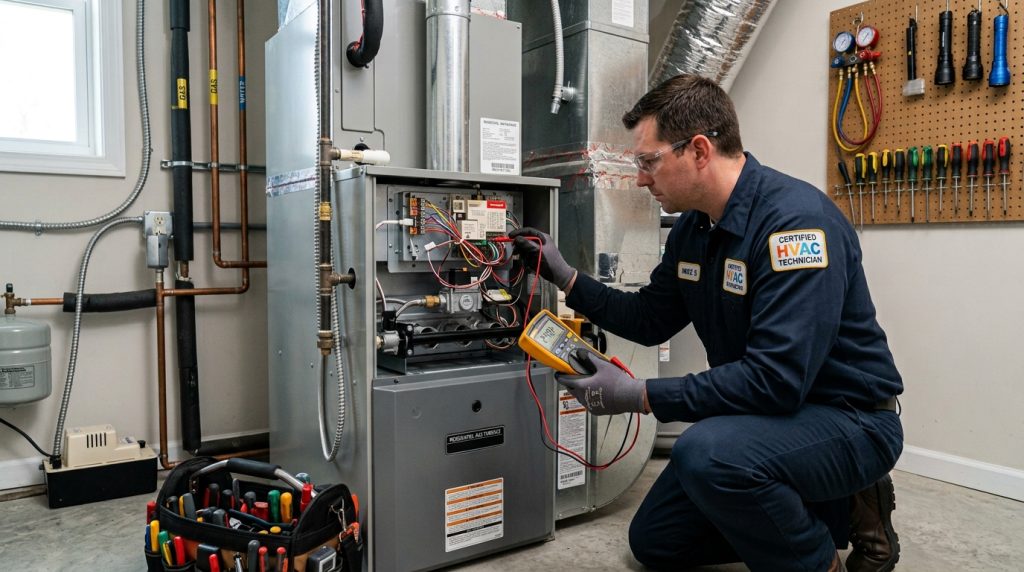
Repair is often appropriate when the furnace remains fundamentally sound.
For example, professional furnace repair in Ann Arbor, MI may make sense when the equipment has otherwise performed reliably and the problem involves a serviceable component.
Common repairable furnace problems can involve:
- Ignition components
- Flame sensors
- Thermostats
- Capacitors
- Blower components
- Electrical controls
- Limit switches
The existence of one failed component does not mean the entire furnace has reached the end of its service life.
Repair tends to be more attractive when:
- The furnace is not unusually old.
- Previous reliability has been good.
- The repair is relatively minor.
- Heating performance remains satisfactory.
- Energy consumption has not increased significantly.
- No major safety issue has been identified.
In these circumstances, repairing the furnace may provide additional years of useful operation without the expense of immediate replacement.
When Furnace Replacement Deserves Serious Consideration
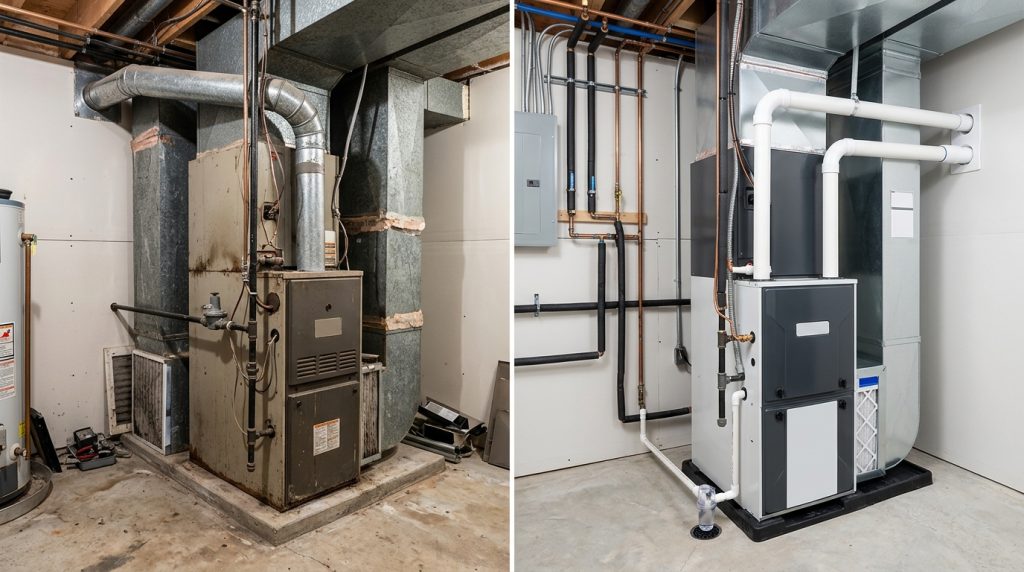
Replacement becomes more compelling when problems are no longer isolated.
An aging furnace that requires repeated repairs while providing increasingly inconsistent heating can become expensive to keep operating.
Potential replacement indicators include:
- Increasingly frequent breakdowns
- Major component problems
- Rising heating costs
- Difficulty maintaining thermostat settings
- Excessive operating noise
- Uneven heating
- Increasing repair expenses
- Significant safety concerns
Homeowners should pay particular attention when several of these symptoms appear together.
Replacing a furnace solely because it has reached a particular birthday may be premature. But continuing to invest heavily in equipment that is simultaneously becoming less efficient, less reliable, and more expensive to repair may also provide poor long-term value.
How Furnace Age Affects the Decision
Age is useful context, but it should not function as an automatic replacement rule.
ENERGY STAR suggests considering replacement when a furnace or boiler is more than 15 years old, particularly when other performance or efficiency concerns are present. Its guidance also points homeowners toward professional evaluation rather than relying on age alone. ENERGY STAR guidance on replacing heating and cooling equipment
An older furnace that has received regular maintenance and continues operating efficiently may remain serviceable.
A younger furnace with a major problem could still require substantial repair.
The better question is therefore not simply:
“How old is the furnace?”
It is:
“Given its age, condition, efficiency, repair history, and current problem, how much reliable service is this furnace reasonably likely to provide?”
Compare the Repair Cost With Future Costs
Suppose a furnace needs a substantial repair.
Looking only at the repair estimate can make repairing seem considerably less expensive than replacement. However, the homeowner should also consider what is likely to happen after that repair.
Questions worth asking include:
- Are other major components showing wear?
- Has the furnace needed repairs recently?
- Are replacement parts becoming difficult to obtain?
- Has heating performance declined?
- Have energy costs increased?
- How long is the repaired furnace reasonably expected to remain dependable?
A $1,000 repair that produces several more years of reliable service could represent good value.
The same repair becomes much less attractive if another expensive component is likely to fail soon afterward.
Energy Efficiency Changes the Financial Calculation
An older furnace may continue heating the home while consuming considerably more fuel than newer equipment.
The U.S. Department of Energy explains that furnace efficiency is represented by annual fuel utilization efficiency (AFUE), which indicates how much of the fuel consumed by a furnace becomes useful heat. U.S. Department of Energy furnace and boiler guidance
When comparing repair and replacement, homeowners should therefore consider both:
Immediate cost: What does the repair or replacement cost today?
Operating cost: What is the furnace likely to cost to operate over the coming years?
Higher-efficiency equipment does not automatically make replacement financially worthwhile in every situation. However, efficiency becomes increasingly relevant when an older furnace also has high repair costs and declining reliability.
Safety Should Be Evaluated Separately From Cost
Some furnace problems deserve more urgency than ordinary comfort complaints.
Combustion appliances require appropriate venting and safe operation. Problems involving combustion, venting, gas, or a damaged heat exchanger should be professionally evaluated rather than treated as routine DIY repairs.
The U.S. Environmental Protection Agency identifies combustion sources as potential contributors to indoor air pollutants and emphasizes proper maintenance and ventilation of fuel-burning appliances. EPA guidance on combustion pollutants in the home
If a professional identifies a significant safety problem, the repair-versus-replacement decision may need to prioritize safe operation rather than simply selecting the least expensive option.
Furnace Installation Quality Matters if Replacement Wins
Choosing replacement equipment is only half of the decision.
The quality of the furnace installation can have a major effect on comfort, efficiency, reliability, and equipment life.
A replacement project should consider:
- Heating load calculations
- Correct furnace capacity
- Existing ductwork
- Airflow
- Venting requirements
- Thermostat compatibility
- Equipment efficiency
- Installation specifications
Simply replacing an old furnace with another unit of approximately the same capacity does not necessarily mean the new equipment is correctly sized.
A professional assessment should evaluate the home’s actual heating requirements before selecting replacement equipment.
Signs a Furnace Repair May Only Postpone Replacement
Some repairs restore a furnace to reliable operation for years. Others solve the immediate problem while leaving homeowners with equipment that is still approaching the end of its useful life.
The distinction often becomes clearer when several factors occur together.
A repair may provide only short-term value when:
- Multiple components have recently failed.
- Repair costs are increasing from year to year.
- Heating performance remains inconsistent after previous repairs.
- The furnace operates noticeably longer than it once did.
- Replacement parts are becoming difficult or expensive to obtain.
- Energy consumption continues increasing.
- A major component requires an expensive repair.
ENERGY STAR identifies a furnace older than 15 years, frequent repairs, rising energy bills, comfort problems, and excessive system noise among the reasons homeowners should consider having their equipment evaluated for replacement.
None of these factors independently proves that replacement is necessary. The overall pattern matters more.
Three Common Repair-vs.-Replacement Scenarios
Understanding a few typical situations can make the decision easier.
Scenario 1: A Younger Furnace With One Minor Failure
Consider a furnace that has operated reliably for eight years but suddenly develops an ignition or electrical-control problem.
If:
- The repair is reasonably priced.
- The heat exchanger is in good condition.
- The furnace has been properly maintained.
- Energy consumption remains reasonable.
- There is no pattern of repeated failures.
Repairing the equipment would generally deserve serious consideration.
Replacing an otherwise healthy furnace because of one serviceable component may provide little financial benefit.
Scenario 2: An Older Furnace With Repeated Repairs
Now consider a furnace that is more than 15 years old and has required several service calls within the last two heating seasons.
The homeowner may also have noticed:
- Increasing gas consumption
- Longer heating cycles
- More operating noise
- Uneven temperatures
In this situation, another repair should be evaluated in the context of the entire system rather than as an isolated expense. ENERGY STAR specifically recommends considering replacement when older equipment needs frequent repairs while energy bills are increasing.
Scenario 3: An Older Furnace With a Major Problem
The decision becomes more urgent when an aging furnace develops a major mechanical or safety-related problem.
Before authorizing an expensive repair, homeowners should ask how much useful life is realistically expected after the repair.
If several other major components are also showing significant wear, replacement may offer greater long-term value.
Consider How Long You Plan to Own the Home
Homeownership plans can also affect the financial calculation.
Someone planning to remain in a home for another decade may place greater value on:
- Long-term energy savings
- Equipment reliability
- A new manufacturer warranty
- Improved comfort
- Reduced likelihood of emergency repairs
Someone planning to move relatively soon may evaluate the same investment differently.
However, installing new equipment solely because a home will eventually be sold is not automatically necessary. The condition and reliability of the existing furnace should remain central to the decision.
Don’t Ignore the Rest of the Home
Replacing a furnace does not automatically correct every heating problem.
A home may still experience comfort or efficiency issues because of:
- Leaking ductwork
- Inadequate insulation
- Air leakage
- Poor airflow
- Incorrect duct sizing
- Thermostat location
- Improper system design
ENERGY STAR recommends addressing air leaks and duct-system problems when evaluating HVAC performance because the equipment itself may not always be the underlying source of poor comfort.
This is particularly important when homeowners are considering furnace replacement. A comprehensive evaluation can help determine whether replacing the furnace alone will solve the existing comfort problems.
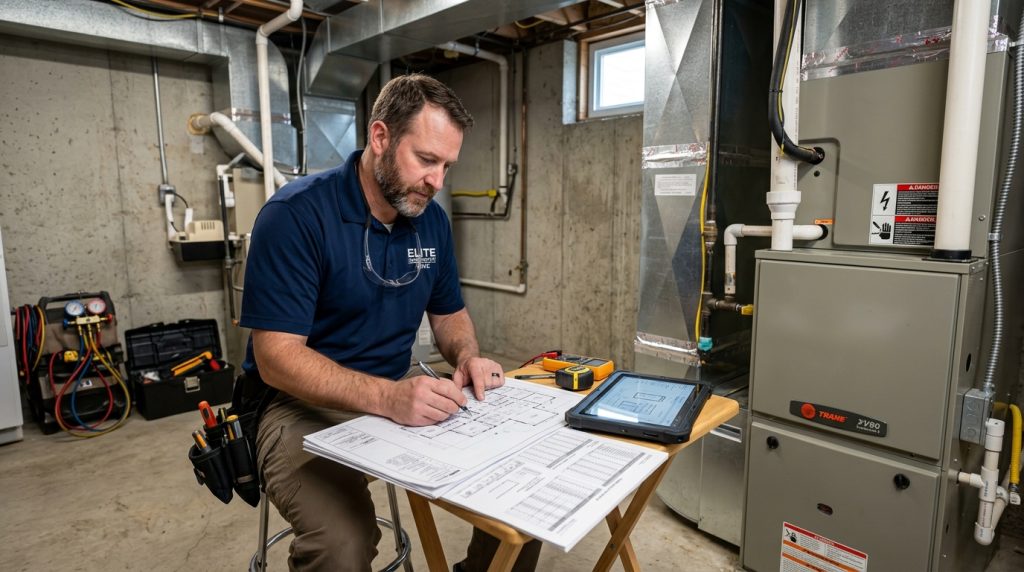
Why Proper Furnace Sizing Matters
Installing the largest furnace available does not necessarily produce better heating.
An oversized furnace may heat the home rapidly and then shut down before completing an efficient operating cycle. Repeated short cycling can affect comfort and contribute to unnecessary equipment wear.
A furnace that is too small may struggle to maintain the desired temperature during colder weather.
ENERGY STAR recommends using the actual characteristics of the home to determine properly sized HVAC equipment rather than relying on simple rules of thumb.
A professional furnace installation should therefore account for factors such as:
- Home size and layout
- Insulation
- Window characteristics
- Air leakage
- Local design temperatures
- Existing ductwork
- Heating requirements
Correct sizing can improve comfort while helping new equipment operate as intended.
Compare Warranty Coverage
Warranty status can significantly affect a repair decision.
A relatively young furnace may still have manufacturer coverage for certain components, which can make repair considerably more attractive.
Homeowners should determine:
- Whether the equipment is still under warranty
- Which components are covered
- Whether labor is included
- Whether registration was required
- Whether maintenance requirements affect coverage
For replacement equipment, compare both manufacturer and contractor-provided warranties.
The longest warranty is not automatically the best offer. Homeowners should understand what is actually covered and which costs remain their responsibility.
Maintenance History Can Influence the Decision
A furnace that has received regular professional maintenance provides a clearer maintenance and performance history than equipment that has been neglected for years.
Maintenance may help identify:
- Combustion problems
- Electrical issues
- Airflow restrictions
- Dirty burners
- Control problems
- Developing mechanical wear
ENERGY STAR recommends annual pre-season heating-system checkups and lists inspection of gas connections, burner combustion, controls, and heat exchangers among heating-specific maintenance tasks.
Regular maintenance cannot prevent every failure, but it can help identify problems earlier and provide useful information about the furnace’s overall condition.
Questions to Ask Before Authorizing a Furnace Repair
When facing a substantial repair estimate, homeowners should ask the technician for more context than simply the price of the replacement part.
Useful questions include:
- What exactly failed?
- What caused the failure?
- Is this an isolated problem?
- What condition are the other major components in?
- Are there any safety concerns?
- How much useful life might remain after the repair?
- Has the furnace’s efficiency declined?
- Are replacement parts readily available?
- Is any portion of the repair covered by warranty?
- What would comparable replacement equipment cost?
The goal is not to force a contractor to predict exactly when the furnace will fail. Mechanical equipment is inherently unpredictable.
Instead, these questions help homeowners understand the relative risk of investing additional money in the existing equipment.
Questions to Ask Before Choosing Furnace Replacement
If replacement appears more practical, homeowners should shift their attention from whether to replace the furnace to how the new system should be selected.
Important questions include:
- How was the recommended furnace size calculated?
- What efficiency rating does the equipment provide?
- Does the existing ductwork need modification?
- What type of blower motor is included?
- What warranties apply?
- Are permits required?
- What maintenance does the manufacturer recommend?
- How will airflow be tested after installation?
For Michigan specifically, the state’s mechanical regulations cover HVAC equipment, ductwork, gas piping, and venting, and permit and inspection requirements may apply depending on the project and jurisdiction.
Selecting a Contractor for Furnace Repair or Replacement
Whether the final decision is repair or replacement, the quality of the professional evaluation matters.
When arranging furnace repair in Ann Arbor, MI, homeowners may want to evaluate:
- Appropriate licensing
- Furnace diagnostic experience
- Written repair recommendations
- Transparent pricing
- Installation capabilities
- Warranty support
- Maintenance services
- Knowledge of Michigan heating requirements
Customer feedback can provide another layer of information. Reviewing public business profiles can help homeowners examine reported customer experiences alongside qualifications, licensing, warranties, and technical expertise.
Reviews should support the contractor-selection process rather than replace it.
Avoid Making the Decision During an Emergency When Possible
A furnace failure during a cold Michigan night can create pressure to make a rapid decision.
When an aging furnace begins developing warning signs before complete failure, homeowners have an opportunity to investigate their options in advance.
That may include:
- Obtaining a professional system assessment
- Reviewing recent repair history
- Comparing replacement options
- Understanding efficiency ratings
- Checking warranty coverage
- Evaluating financing or budget requirements
Planning does not mean homeowners must replace functioning equipment immediately. It simply reduces the likelihood of having to make a major financial decision during an emergency.
Conclusion
Neither furnace repair nor furnace replacement is automatically the better choice.
Repair usually makes sense when the furnace remains fundamentally reliable and the current problem is isolated, affordable to correct, and unlikely to be followed by additional major failures.
Replacement becomes more compelling when an older furnace combines several unfavorable factors: frequent repairs, rising operating costs, declining comfort, major component problems, reduced reliability, or significant safety concerns.
Homeowners should therefore avoid relying on a single rule based solely on furnace age or repair price.
Instead, compare the current repair cost, previous repair history, equipment condition, energy efficiency, safety, expected remaining life, warranty status, and long-term ownership plans.
A thorough professional evaluation can provide the technical information needed to make that comparison. The ultimate goal is not simply to spend the least money today—it is to choose the option that provides dependable, safe, and economically reasonable heating over the years ahead.
Frequently Asked Questions
When is furnace repair usually the better option?
Furnace repair is often the better choice when the equipment is relatively young, the problem is isolated, maintenance history is good, and the repair cost is modest compared with replacement. A professional furnace repair in Ann Arbor, MIevaluation can help determine whether the issue is limited to one component or part of a broader decline in system reliability.
When does furnace replacement make more sense?
Furnace replacement becomes more attractive when the system is older, requires increasingly frequent repairs, has major component problems, uses significantly more energy than newer equipment, or no longer heats the home consistently.
Is furnace age enough to justify replacement?
No. Age is important, but it should be considered alongside repair history, efficiency, comfort, safety, and the condition of major components. An older furnace that is well maintained and reliable may still have useful life remaining.
How many furnace repairs are too many?
There is no universal number. The more important pattern is whether repairs are becoming more frequent, more expensive, or involve multiple major components. Repeated breakdowns over a short period can indicate that replacement deserves consideration.
Should I replace a furnace that still works?
Not necessarily. A functioning furnace may still be worth keeping if it remains safe, efficient, reliable, and reasonably inexpensive to maintain. Replacement becomes more compelling when operating costs and repair risk continue to rise.
Can a new furnace lower heating bills?
Yes, particularly when replacing older, less efficient equipment. Actual savings depend on the efficiency of both the old and new systems, fuel costs, home insulation, thermostat use, and installation quality.
How important is proper furnace sizing?
Very important. Oversized equipment can short cycle, while undersized equipment may struggle during cold weather. Professional furnace installation should include a proper heating-load assessment rather than relying only on the capacity of the old furnace.
Does maintenance extend furnace life?
Routine maintenance can help identify developing problems early, keep combustion and airflow components operating correctly, and reduce unnecessary wear. It cannot prevent every failure, but it can support reliability and efficiency.
Is a major repair worth making on an older furnace?
Sometimes, but the decision should include expected remaining service life, the condition of other components, repair history, warranty coverage, and the cost of replacement. A large repair that only postpones another major failure may offer poor long-term value.
How does a furnace warranty affect the repair-or-replace decision?
Warranty coverage can make repair more attractive if expensive components are still covered. Homeowners should confirm which parts are included, whether labor is covered, and whether registration or maintenance requirements apply.
What safety concerns can make furnace replacement more urgent?
Problems involving combustion, gas, venting, or a compromised heat exchanger deserve prompt professional evaluation. Significant safety concerns may outweigh the financial argument for keeping older equipment.
What should homeowners ask before replacing a furnace?
Useful questions include:
- How was the recommended furnace size calculated?
- What efficiency rating does the new furnace provide?
- Does the ductwork need modification?
- What warranties are included?
- Are permits or inspections required?
- How will airflow be tested after installation?
These questions help homeowners compare replacement proposals more effectively.